 Robert Andrison
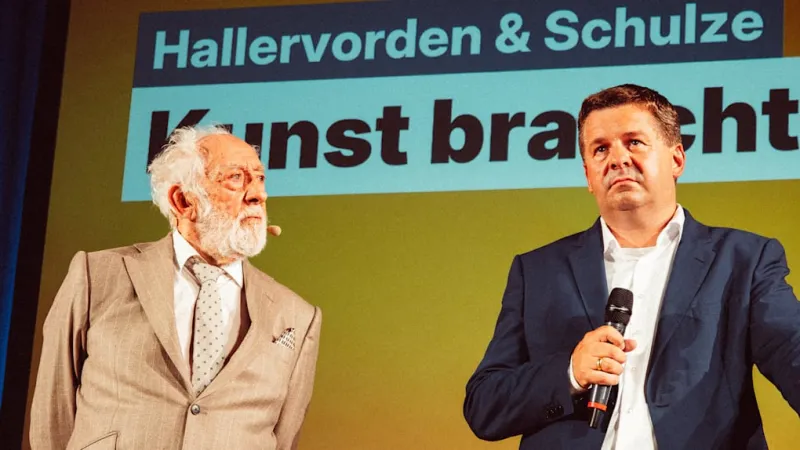
Dessau, Germany – Veteran German entertainer Dieter Hallervorden continues to generate controversy and garner thunderous applause during his campaign appearances for CDU Minister-President Sven Schulze, raising significant questions about the effectiveness of a strategy that sees the candidate often overshadowed by his prominent supporter. This dynamic has sparked a national debate regarding the role of celebrity endorsement in modern German politics, particularly as Saxony-Anhalt approaches a crucial election.
The involvement of Hallervorden, known for his satirical roles and outspoken nature, has not been without its critics. His initial appearances drew swift condemnation from various political factions and media commentators, who questioned the appropriateness of his sometimes provocative remarks on the campaign trail. Despite the backlash, the CDU campaign in Saxony-Anhalt has evidently opted to continue leveraging his star power.
In Dessau, the veteran performer once again took center stage, drawing a considerable crowd that responded with enthusiastic cheers and applause. Eyewitnesses reported a palpable energy, though much of the focus remained squarely on Hallervorden himself, with Schulze often perceived as a secondary figure at his own rallies.
Minister-President Schulze, who is seeking re-election, has largely stood by the campaign's decision to feature Hallervorden prominently. The strategy appears to aim at energizing the voter base and attracting attention, though it risks diluting the candidate's own message and platform amidst the surrounding spectacle.
The public's reaction has been polarized. Supporters view Hallervorden's presence as a refreshing, authentic element in an often staid political landscape, praising his ability to connect with everyday people. Detractors, however, argue that his involvement trivializes serious political discourse and diverts attention from substantive policy debates. Major news outlets across Germany have extensively covered the phenomenon, analyzing its implications for the upcoming elections.
Celebrity endorsements are not new in politics, but the intensity and controversy surrounding Hallervorden's role highlight a unique situation. Historically, such figures have often played supporting roles, adding glamour without overshadowing the principal candidate. This current approach by the CDU for Schulze represents a more aggressive integration of a personality that, for better or worse, commands significant public attention independently.
Political strategists are divided on whether this unconventional approach can ultimately benefit Schulze. While the large crowds are undeniable, converting that enthusiasm into votes for the specific candidate, rather than just appreciation for the celebrity, remains the core challenge. The question lingers: Is the applause for the message or the messenger?
A significant risk for Schulze is the potential for long-term brand association. If voters primarily remember the campaign for Hallervorden's antics rather than Schulze's governance or policy proposals, the strategy could backfire. It could also alienate more traditional or serious-minded voters who prefer a focus on policy substance.
This situation also reflects a broader trend in political campaigning, where the lines between entertainment and serious political engagement are increasingly blurred. As parties grapple with voter apathy and the fragmented media landscape, the allure of a popular figure like Dieter Hallervorden becomes a powerful, albeit risky, tool. This echoes some discussions around the impact of public figures in other European political landscapes, such as the normalization debate surrounding certain public officials in Germany.
While other CDU politicians have faced their own challenges, such as a CDU politician losing a license amid a drug influence probe, the Hallervorden situation is distinct due to its deliberate and high-profile nature as a campaign strategy. It signals a willingness to take risks to capture public imagination, even if it means navigating controversial waters.
As the election draws nearer, all eyes will be on Saxony-Anhalt to see whether the Hallervorden phenomenon translates into electoral success for Sven Schulze. The outcome could set a precedent for future political campaigns, influencing how German parties utilize celebrity endorsements in an increasingly personality-driven political arena.
The central question remains: Can a campaign built around a charismatic, yet polarizing, celebrity genuinely elevate a political candidate without overshadowing them entirely? The upcoming election results will provide the definitive answer to whether this bold strategy proved to be a masterstroke or a miscalculation.