 Debby Wijaya
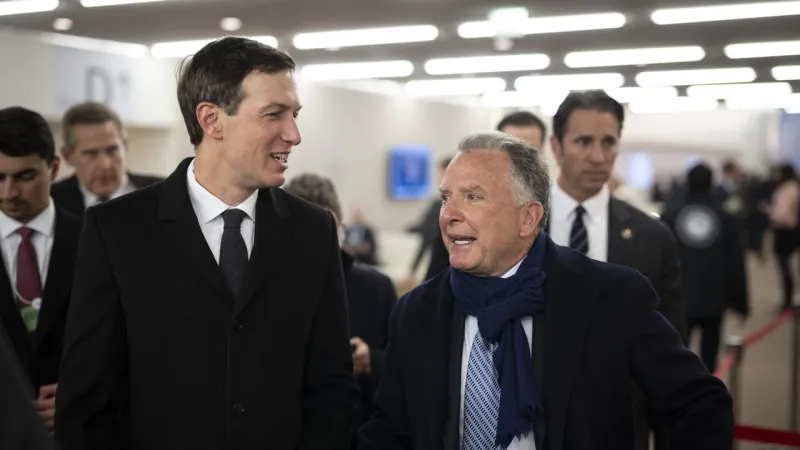
MOSCOW – Jared Kushner and Steven Witkoff, influential figures with close ties to President Donald Trump's administration, landed in Moscow today aboard a private jet, sparking intense speculation over their unannounced mission. The visit comes as Russian Deputy Foreign Minister Sergei Ryabkov issued a pointed warning, stating the United States must "take into account the situation on the ground."
The arrival of Kushner, President Trump's son-in-law and former senior advisor, alongside prominent real estate developer Witkoff, has immediately drawn scrutiny from international observers. Their presence in the Russian capital, devoid of official public announcements, suggests a highly sensitive, perhaps back-channel, diplomatic effort.
Sources close to Washington political circles, who requested anonymity due to the delicate nature of the matter, suggested the visit might be connected to President Trump's ongoing efforts to de-escalate global conflicts. This aligns with recent reports that President Trump initiates Ukraine peace talks with key envoys, a policy he has consistently championed.
Deputy Foreign Minister Ryabkov's statement, delivered earlier today, underscored Russia's firm stance on current geopolitical realities. While he did not explicitly link his remarks to the incoming American delegation, the timing of his pronouncement appears highly significant.
Ryabkov's phrasing, "the situation on the ground," is widely interpreted by analysts as a direct reference to ongoing military and political dynamics in Eastern Europe and beyond. This language frequently accompanies Russian demands for international recognition of its asserted interests and territorial claims.
Neither the White House nor representatives for Kushner or Witkoff have released any official statements regarding the purpose or duration of their Moscow itinerary. This silence further fuels conjecture that the visit is an exploratory dialogue operating outside traditional diplomatic protocols.
Jared Kushner previously served as a key architect of President Trump's foreign policy initiatives during his first term, particularly in the Middle East. His return to an active, albeit unofficial, role in international affairs indicates the continued utilization of trusted personal emissaries by the current administration.
Steven Witkoff, a long-time associate and business partner of President Trump, has maintained a lower profile in foreign policy circles. His inclusion in this high-stakes delegation suggests a multi-faceted approach, potentially involving economic considerations or a broader strategy beyond conventional diplomacy.
The geopolitical backdrop to this visit is one of persistent tension between Washington and Moscow. Disagreements over a range of issues, including cyber security, arms control, and regional conflicts, continue to define bilateral relations.
Observers are particularly keen to ascertain whether the discussions in Moscow might touch upon the protracted conflict in Ukraine, a flashpoint that has dominated international headlines for years. President Trump has repeatedly expressed a desire for a swift resolution to the hostilities.
The use of private individuals for such sensitive overtures is not unprecedented in diplomatic history, especially when official channels face gridlock or when a leader seeks to test new avenues for dialogue. Such efforts often carry both high potential and significant risks.
President Trump's administration has often favored a pragmatic approach to foreign policy, sometimes bypassing established diplomatic frameworks in pursuit of direct negotiations. This trip could be seen as an extension of that strategy.
The international community will undoubtedly monitor developments from Moscow closely. Any potential breakthroughs or escalations stemming from these discreet meetings could profoundly impact global stability.
This trip also raises questions about the future trajectory of US-Russia relations under President Trump's second administration. His approach has often emphasized direct negotiation and personal relationships over established bureaucratic processes.
The implications of Moscow's "situation on the ground" warning cannot be overstated. It serves as a reminder of the complex and often intractable challenges that any diplomatic initiative between these two global powers must navigate. While the specifics remain guarded, the sheer presence of Kushner and Witkoff in the Russian capital signifies a moment of elevated engagement, however informal. The world awaits any indication of the outcomes of these high-stakes private consultations.