 Edward DP Situmorang

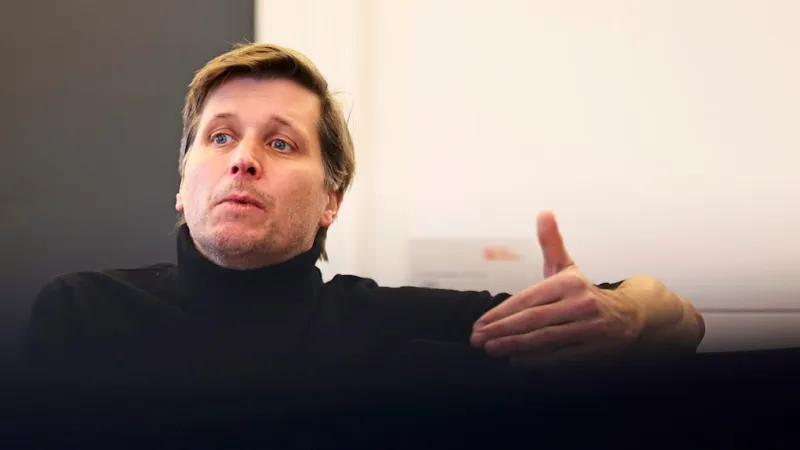
Germany -- Linken Party leader Luigi Pantisano has signaled his party's readiness to back a Christian Democratic Union (CDU) candidate for Minister President in Saxony-Anhalt. Pantisano conveyed this willingness during a recent ZDF Sommerinterview, emphasizing the critical objective of thwarting any potential power ascension by the far-right Alternative for Germany (AfD) in the eastern German state.
This declaration marks a significant moment in German politics, especially within Saxony-Anhalt, where the AfD has consistently gained ground in recent years. The prospect of The Left, a party with roots in East German communism, aligning with the center-right CDU to block the far-right underscores the evolving and often contentious political landscape.
Pantisano's statement specifically referenced CDU politician Sven Schulze, positioning him as a viable option for the state's highest office. The move suggests a pragmatic approach from The Left, prioritizing the prevention of a perceived extremist government over strict ideological adherence in a fractured political environment.
The political calculus behind such an unexpected alliance is clear: unite disparate forces against a common opponent. The AfD's rise has prompted many mainstream parties to reconsider long-standing rivalries, often leading to unconventional coalitions or understandings to maintain a democratic firewall against the party's agenda.
For the CDU, accepting such support from The Left would also represent a significant departure from traditional conservative principles. However, the imperative to prevent an AfD led government in a crucial state like Saxony-Anhalt appears to be driving these unprecedented considerations.
Saxony-Anhalt, like several other eastern German states, has witnessed a notable surge in support for the AfD, fueled by concerns over immigration, economic disparities, and national identity. This electoral trend has made forming stable, traditional coalitions increasingly challenging.
Political analysts suggest that Pantisano's public overture might also pressure other center-left parties, such as the Social Democrats (SPD) and the Greens, to consider similar strategic alliances. The broader implications for federal politics remain substantial, as state-level experiments often set precedents for national cooperation or conflict.
Historically, The Left and the CDU have occupied diametrically opposed ends of the political spectrum. The Linken Party emerged from the Party of Democratic Socialism (PDS), the successor to the former East German communist party (SED), while the CDU has been Germany's dominant conservative force since post-war reconstruction.
This potential alliance speaks to a broader national anxiety regarding the AfD's growing influence. Concerns over the party's policies, particularly on immigration and European integration, have prompted calls for a united front among established parties. For example, ongoing debates about Germany's SPD Calls for Softer Family Reunion Hardship Rules illustrate the kind of social issues where political lines are drawn, often creating fertile ground for extremist narratives.
The challenge for both The Left and the CDU will be to justify such a tactical alliance to their respective voter bases, many of whom hold deep-seated ideological differences. The success of such a strategy hinges on whether voters will prioritize stability and the blocking of the far-right over traditional party loyalty.
The coming months will reveal whether this proposal leads to a concrete political arrangement in Saxony-Anhalt. The willingness of traditional rivals to overcome historical animosities for a shared political goal could reshape Germany's political landscape, demonstrating the lengths to which parties are willing to go to manage the rise of the AfD.
This situation underscores the fluidity of German state politics in 2026, where the fragmentation of the electorate and the rise of populist movements necessitate innovative, albeit sometimes controversial, approaches to governance.