Dorry Archiles
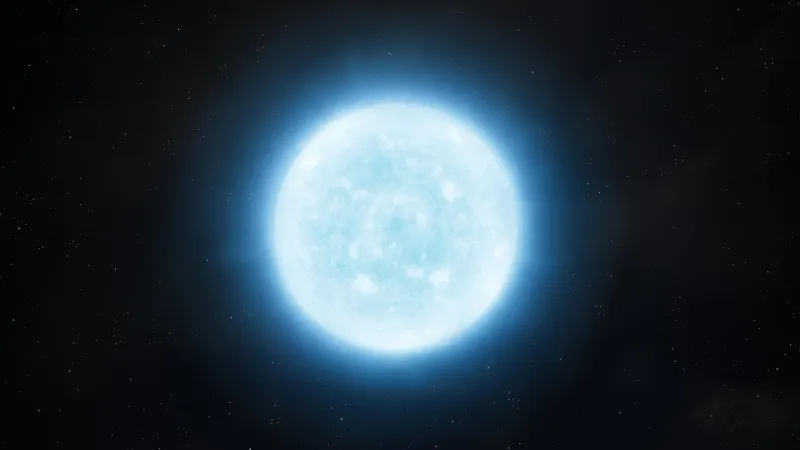
CAMBRIDGE, Mass. – A new paradigm in astrophysics is emerging as surprising computer simulations indicate that some white dwarfs, the dense remnants of dead stars, can attain masses far greater than theoretical limits previously allowed. This groundbreaking research suggests that powerful magnetic fields permit these stellar corpses to swell to 2.4 times the Sun's mass, fundamentally challenging a famous astronomical boundary established decades ago and offering a compelling explanation for the origins of unusually luminous supernova explosions that have long perplexed scientists.
White dwarfs represent the final evolutionary stage for stars up to eight times the mass of our Sun, having exhausted their nuclear fuel and shed their outer layers. These compact objects, typically about the size of Earth, possess immense density, with a single spoonful weighing tons. For nearly a century, their maximum possible mass has been a cornerstone of stellar physics.
The critical boundary in question is the Chandrasekhar Limit, calculated by Indian astrophysicist Subrahmanyan Chandrasekhar in 1930. This limit, approximately 1.4 times the mass of the Sun, defines the maximum mass a white dwarf can sustain before its internal electron degeneracy pressure succumbs to gravitational collapse, typically resulting in a Type Ia supernova or further collapse into a neutron star.
The new findings, published in a leading astronomy journal, posit that immensely powerful magnetic fields fundamentally alter the internal structure of white dwarfs. These fields, estimated to be hundreds of millions of times stronger than Earths, introduce a new source of pressure that helps counteract the relentless pull of gravity.
Scientists employing sophisticated computer models demonstrated that these super-strong magnetic fields could effectively prop up a white dwarf, allowing it to accumulate additional mass without collapsing. The simulations showed that under these conditions, a white dwarf could reach an astonishing 2.4 solar masses, nearly double the established Chandrasekhar Limit.
This phenomenon has significant implications for Type Ia supernovae, often dubbed standard candles because of their consistent peak luminosity. These stellar explosions are crucial for measuring cosmic distances and understanding the universe's expansion. However, some Type Ia supernovae have been observed to be much brighter than expected, presenting a persistent puzzle for astronomers.
The existence of white dwarfs exceeding the Chandrasekhar Limit provides a compelling solution to this enigma. A super-massive white dwarf, upon accumulating enough material from a companion star to reach this enhanced collapse threshold, would unleash an explosion of greater energy and luminosity, aligning with observations of these unusually bright supernovae.
“This discovery could literally rewrite chapters in our astrophysics textbooks,” remarked Dr. Elena Petrova, lead researcher on the project. “For decades, the Chandrasekhar Limit has been an untouchable truth. To find a mechanism that bypasses it opens up entirely new avenues for understanding stellar death and the violent events that shape our cosmos.”
The simulations specifically modeled the complex interplay between gravity, electron degeneracy pressure, and the magnetic field's influence on electron behavior within the white dwarf's core. The results consistently pointed to the magnetic field providing sufficient additional resistance to gravitational forces.
This research not only challenges a foundational concept in stellar evolution but also highlights the profound, sometimes unexpected, role that magnetic fields play in cosmic phenomena. From the formation of stars to the dynamics of galaxies, magnetism is increasingly recognized as a vital, active force.
The implications extend beyond supernovae. A deeper understanding of these super-massive white dwarfs could refine models of chemical element distribution throughout the universe, as supernovae are primary factories for heavy elements essential for planet and life formation.
While based on advanced computational modeling, the scientific community anticipates future observational campaigns aimed at detecting direct evidence of these super-massive, highly magnetized white dwarfs. Such discoveries would provide crucial validation for the theoretical predictions.
Astronomers frequently scan the skies for cosmic marvels, from meteor showers to distant nebulae, constantly expanding humanitys understanding of the universe. For instance, recent celestial events, including spectacular meteor showers and the journey of Voyager 1 into deep space, remind us of the vastness and dynamism of the cosmos, as explored in articles like November Skies Blaze: Meteor Showers, Supermoon, Voyager 1 Marks Deep Space First.
This breakthrough underscores the dynamic nature of scientific inquiry, where long-standing theories are continuously tested and refined with new data and advanced computational capabilities. It is a testament to the persistent human endeavor to unravel the universe's deepest secrets.
The research team plans to conduct further simulations, exploring a wider range of magnetic field configurations and stellar compositions to better understand the conditions under which these super-massive white dwarfs can form. Their goal is to provide a comprehensive framework for their existence.
The potential to solve the riddle of unusually bright supernovae represents a significant stride forward in cosmology. By providing a coherent explanation for these powerful cosmic explosions, scientists can more accurately gauge the universe's expansion rate and its ultimate fate.
Ultimately, this discovery pushes the boundaries of what was once considered immutable law in stellar physics. It forces a re-evaluation of fundamental processes governing the most extreme objects in the universe and reiterates that even the most established scientific tenets are subject to revision in the face of new evidence.
The implications extend across theoretical astrophysics, potentially impacting our understanding of gravitational wave events involving compact objects, as well as the formation of exotic stellar remnants.
This work ensures that the study of stellar evolution remains a vibrant and evolving field, promising further revelations about the dramatic lives and deaths of stars that populate our cosmos.