 Chandra Wijayanto
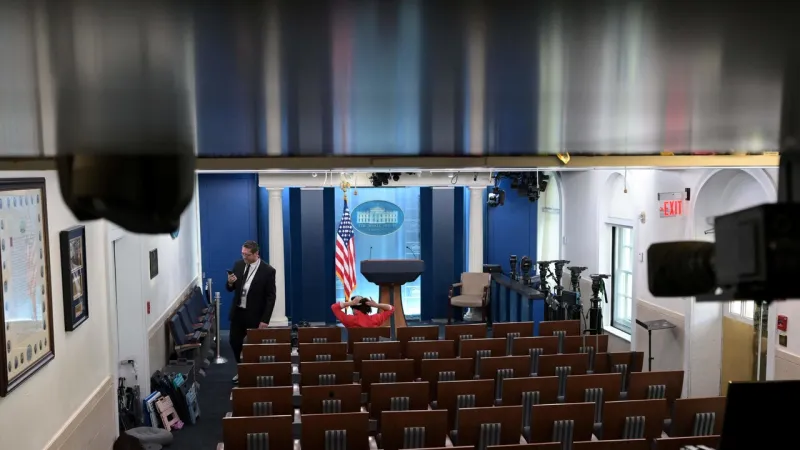
Washington, D.C. – Three prominent national news organizations, CNN, MSNBC, and Politico, have initiated legal action against President Donald Trump, challenging what they describe as unprecedented restrictions on White House access for their journalists. The lawsuit, filed [implied recently, given 2026 context], seeks to affirm the fundamental rights of a free press to cover the executive branch, marking a significant escalation in the ongoing tension between the administration and major media outlets.
The legal challenge focuses on the administration's alleged pattern of denying White House press credentials and limiting reporter presence at critical briefings and events. Plaintiffs argue these actions impede their ability to inform the public and violate the First Amendment's guarantees of press freedom and due process.
President Trump has consistently voiced strong criticism of several news organizations, often labeling unfavorable coverage as 'fake news.' In a recent statement addressing the growing friction, President Trump asserted, "I am not attacking the free press but fake news, they are a threat." This distinction, however, is at the heart of the current legal battle.
The plaintiffs contend that the administration's definition and application of 'fake news' are subjective and used as a pretext to silence critical reporting rather than address factual inaccuracies. Their filing emphasizes that journalistic scrutiny, even when critical, is a cornerstone of democratic governance.
Historically, presidential administrations have maintained a complex but generally cooperative relationship with the White House press corps. While tensions have always existed, outright legal challenges of this nature regarding fundamental access are rare, signaling a deepening divide in 2026.
The lawsuit is expected to delve into the parameters of executive privilege versus the public's right to information, a constitutional clash with profound implications. Legal scholars anticipate vigorous arguments from both sides regarding the scope of presidential authority over media relations and White House access.
Advocacy groups for press freedom, such as the Reporters Committee for Freedom of the Press, have expressed solidarity with the plaintiffs. They argue that unrestricted White House access is vital for accountability and ensures that government operations are transparent to citizens.
The legal proceedings will likely focus on whether the White House's actions constitute a legitimate exercise of administrative control or an unconstitutional attempt to suppress unfavorable reporting. The outcome could set new precedents for media access to government institutions.
This is not the first instance of media organizations pushing back against the Trump administration's policies concerning journalists. Previous incidents involved specific journalists losing credentials, which were often reinstated after public outcry or minor legal threats. This current lawsuit, however, represents a more comprehensive and organized legal offensive to secure consistent White House access.
The White House has yet to issue a formal statement specifically on the lawsuit, but President Trump's past remarks consistently defend his administration's approach to media engagement. His administration maintains that it has a right to manage access to ensure productive interactions and to address what it perceives as biased reporting.
Media experts suggest that the resolution of this case could redefine the boundaries of media-government relations for future administrations. It underscores the critical role of the judiciary in mediating disputes that touch upon core constitutional principles.
The lawsuit highlights broader concerns about journalistic independence and the challenges faced by news organizations in an increasingly polarized political landscape. The ability of journalists to report directly from the seat of power is considered essential for a functioning democracy.
The legal arguments will likely explore precedents set by past court cases concerning government transparency and the rights of journalists to gather news without undue interference. The plaintiffs hope for a ruling that unequivocally upholds consistent White House access for accredited journalists.
The ripple effect of this lawsuit could extend beyond the federal government, potentially influencing how state and local administrations manage their interactions with the press. Its outcome will be closely watched by media organizations and government entities nationwide.
President Trump's administration has often employed direct communication channels, such as social media, to bypass traditional news outlets. Critics argue this strategy further marginalizes the role of professional journalism in conveying official information to the public.
The legal teams for CNN, MSNBC, and Politico are expected to present evidence of systematic patterns of exclusion and selective credentialing. They aim to demonstrate that these actions are not isolated incidents but part of a deliberate strategy affecting White House access.
This case serves as a critical test of the First Amendment's protections in the modern media environment. The question of who defines 'fake news' and how that definition impacts access to centers of power will be central to the court's deliberations.
The journalism community is largely united in supporting the plaintiffs, viewing the legal challenge as a defense of their collective ability to perform their civic duty. The stakes are perceived as exceptionally high for the future of objective reporting from the nation's capital.
The judicial process is anticipated to be lengthy, potentially involving multiple appeals. Regardless of the immediate outcome, the lawsuit itself has already intensified the national conversation about media credibility and the role of the presidency in shaping public discourse.
The battle over White House access underscores the enduring importance of a robust and independent press in holding powerful institutions accountable, a principle that continues to be rigorously debated and defended in the courts and public sphere.