 Chandra Wijayanto
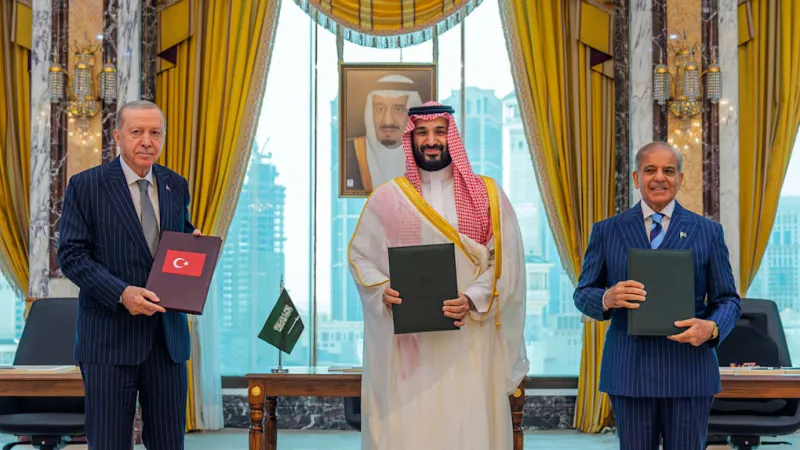
RIYADH – Pakistan, Turkey, and Saudi Arabia have officially established a new defense alliance, dubbed the Mekka Pact, mirroring NATO's collective security principle. This pivotal agreement, asserting that an attack on one member will be considered an assault on all, marks a significant shift in regional geopolitics, with Ankara already advocating for its swift expansion.
The formation of this new military bloc, which seeks to emulate the North Atlantic Treaty Organization's foundational Article 5, signals a clear intent among its founding members to foster a robust collective security framework. The pact aims to deter aggression and ensure mutual defense across their respective territories and strategic interests.
Analysts suggest the alliance emerges from a confluence of shared security concerns, evolving geopolitical landscapes, and a desire among these nations to assert greater autonomy in regional defense matters. The move could reshape traditional power dynamics in both the Middle East and South Asia, creating a powerful new axis.
Turkish leadership has been particularly vocal about the Mekka Pact's potential reach, with officials indicating an ambition to broaden its membership significantly. Ankara views the alliance not merely as a defensive compact for its initial members but as a foundational structure capable of encompassing a wider array of nations.
Indeed, the declaration from Ankara, suggesting that all countries should be brought under this umbrella, underscores a strategic vision extending beyond the current three participants. This expansionist outlook could see other Muslim-majority nations in the Middle East, North Africa, and Central Asia eventually invited to join, further solidifying the pacts regional influence.
Saudi Arabia's involvement highlights its ongoing efforts to diversify its strategic partnerships and enhance its security architecture amidst regional volatilities. The kingdom's participation reinforces its role as a key player in Islamic diplomacy and defense, seeking stability and strength through collective action.
For Pakistan, joining the Mekka Pact offers an opportunity to strengthen its defense ties with influential regional powers and potentially gain access to advanced military technologies and strategic cooperation. Islamabad has historically maintained strong defense relationships, and this alliance could further cement its geopolitical standing.
Observers are keenly watching how the Mekka Pact will interface with existing security arrangements and bilateral agreements in the region. Its establishment could introduce new complexities or offer alternative security paradigms to traditional alliances.
The alliance also presents potential challenges, including the reconciliation of diverse national interests, differing geopolitical priorities, and the logistical complexities of integrating military doctrines and command structures across three distinct defense forces. Financing and resource allocation will also be critical considerations.
The formation of the Mekka Pact occurs amid escalating regional tensions, including Iran's stark warnings about Hormuz closure amid US tensions. This backdrop underscores the urgency and strategic calculation behind creating a robust new defense framework in a volatile part of the world.
International reactions to the Mekka Pact are anticipated to be varied. While some nations may view it as a positive step towards regional stability and self-reliance, others could perceive it as a shift in alliances that might necessitate re-evaluating their own strategic interests.
The United States, under President Donald Trump, maintains significant military presence and diplomatic ties throughout the region. The emergence of the Mekka Pact will undoubtedly factor into Washingtons broader foreign policy and security calculus concerning its allies and strategic partners.
Ultimately, the Mekka Pact represents a bold initiative by Pakistan, Turkey, and Saudi Arabia to forge a powerful, unified defense front. Its evolution and the extent of its expansion will be closely monitored as a defining development in 21st-century global security architecture.