 Dodi Irawan
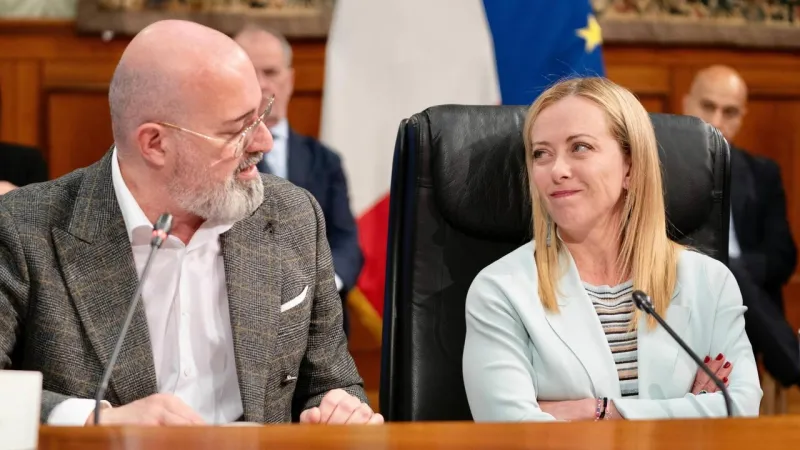
Rome, Italy – Italian Premier Giorgia Meloni recently launched a pointed critique against Democratic Party President Stefano Bonaccini following comments she interpreted as disparaging right-wing voters. Meloni, addressing the nation via a public message on Facebook, asserted that Bonaccini's earlier remarks suggested those who align with conservative ideologies were "ignorant" and deserving of either pity or re-education. This swift rebuttal ignited a fresh wave of political contention, even as Bonaccini clarified his initial statements were aimed as a warning to the left.
The premier's message, widely disseminated across social media platforms, underscored a prevailing sentiment within her Fratelli d'Italia (Brothers of Italy) party regarding perceived condescension from the political opposition. Meloni posited that such rhetoric not only demeans a significant portion of the electorate but also reinforces an outdated notion of intellectual superiority on the part of the progressive establishment.
In her direct response, Meloni stated, "For you, those who vote right are ignorant. For you, they are ignorant to be pitied, if not re-educated." This powerful statement encapsulated her indignation and framed the exchange as a fundamental clash over respect for democratic choice and the intelligence of voters.
Bonaccini's original comments, made public days before Meloni's Facebook post, had stirred debate within political circles. While the exact phrasing that drew Meloni's ire was not fully detailed in the premier's message, it evidently touched upon the perceived intellectual motivations or understanding of right-wing constituents.
In response to the escalating controversy, Bonaccini swiftly issued a clarification, asserting that his remarks were misconstrued. He maintained that he was not maligning right-wing voters but rather delivering a "warning to the left." This clarification sought to redirect the conversation, suggesting his intent was to encourage introspection and strategic thinking within his own political camp, rather than to insult opponents.
This verbal sparring highlights the volatile nature of contemporary Italian politics, where public statements, even those intended for an internal audience, can quickly ignite cross-party feuds. The use of social media as a primary channel for such significant political responses further demonstrates its pervasive influence on shaping public opinion and accelerating political confrontations.
The debate also touches upon deeper societal perceptions of voter intelligence and political allegiance. The accusation of calling voters "ignorant" is particularly potent in a democratic system, as it implies a dismissiveness of electoral outcomes and the collective wisdom of the populace.
Premier Meloni's administration, led by the Fratelli d'Italia, has consistently championed a platform that seeks to empower the common citizen and challenge perceived elitist narratives. This incident aligns with the party's broader strategy of defending its base against what it characterizes as condescending criticism from the left. Indeed, the FdI recently rejected similar overtures regarding political governance, signaling a firm stance against perceived external pressures and a commitment to its core electoral promises.
The exchange between Meloni and Bonaccini undoubtedly deepens the ideological chasm between Italy's right and left. Such rhetoric, while perhaps energizing respective bases, risks further polarizing the political landscape and making cross-party cooperation more challenging.
As 2026 progresses, the political climate in Italy remains charged with frequent and fervent exchanges between leading figures. This latest episode between Premier Meloni and Democratic Party President Bonaccini serves as a testament to the ongoing battle for narrative control and voter perception within the nation's vibrant, often contentious, political arena.