 Demian Sahputra
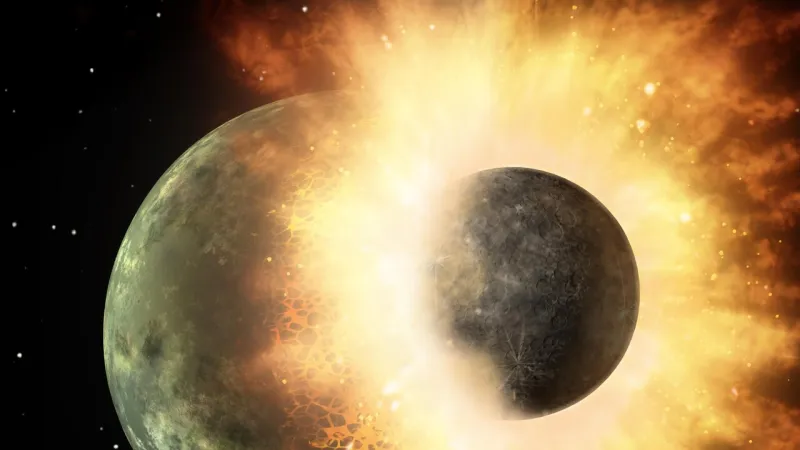
GENEVA, SWITZERLAND – The Earth's Moon, long thought to have coalesced over millennia, may have formed in a startlingly brief window of just a few hours following a cataclysmic collision between early Earth and a Mars-sized protoplanet dubbed Theia. New, high-resolution simulations presented by an international team of astrophysicists are profoundly reshaping our understanding of lunar origin, offering a swift and dynamic alternative to the prevailing gradual accretion model.
This groundbreaking research indicates that the Moon could have emerged directly from the debris ejected into orbit after the giant impact, rather than through a drawn-out process of material accumulation. The findings challenge conventional wisdom, which posited a slower assembly from a disk of fragments orbiting our planet.
For decades, the leading theory for the Moon's creation has been the giant impact hypothesis. This model suggests that approximately 4.5 billion years ago, a nascent Earth collided with Theia, scattering vast amounts of material into space. However, the precise mechanisms and timescale for the subsequent formation of the Moon from this debris have remained subjects of intense debate.
Previous simulations, constrained by computational limitations, typically depicted a more protracted process. These models often showed a disk of hot, vaporized rock and molten material gradually cooling and clumping together over hundreds or thousands of years to form the Moon. The new research, leveraging significantly enhanced computing power, offers a dramatically different narrative.
The advanced simulations employed a sophisticated approach known as smoothed particle hydrodynamics, enabling scientists to model the extreme physics of the impact with unprecedented detail. These models tracked hundreds of millions of individual particles, allowing for a clearer picture of how the superheated material behaved in the immediate aftermath of the colossal collision.
Crucially, the simulations revealed that much of the Moon's mass could have been rapidly ejected into a stable orbit around Earth almost immediately following the impact. This material then quickly condensed and gravitationally self-assembled, circumventing the need for a prolonged accretion phase. The rapid moon formation scenario explains several enigmatic characteristics of our celestial neighbor.
The speed of formation offers compelling answers to the Moon's surprisingly uniform composition, particularly its striking similarity to Earth's mantle. A rapid formation would minimize differentiation and allow less time for distinct layers to separate or for material from Theia to be incorporated unevenly. This helps reconcile the isotopic similarities between lunar and terrestrial rocks.
Furthermore, a swift formation could also shed light on the Moon's highly inclined orbit, a feature that has been difficult to explain with slower accretion models. The violent, high-energy nature of a rapid creation event might naturally imprint such orbital characteristics.
The research team emphasized that while their findings provide a robust new framework, the precise conditions of the Earth-Theia impact remain crucial variables. Factors such as Theia's exact size, impact velocity, and the angle of collision would all influence the trajectory and eventual fate of the ejected material.
This revised timeline for lunar origin has profound implications beyond just our Moon. Understanding how quickly and efficiently celestial bodies can form after catastrophic collisions offers new insights into planetary evolution across the cosmos. It suggests that similar rapid formation events might be more common than previously assumed in other star systems.
The scientific community is now poised to further scrutinize these simulations and explore their ramifications. While the core giant impact hypothesis remains foundational, the precise sequence and speed of events in the ancient solar system are undergoing a significant re-evaluation.
The Moon, a constant beacon in our night sky, continues to yield secrets about its violent birth, reminding us of the dynamic and sometimes instantaneous processes that shaped our cosmic home. This new understanding promises to ignite further inquiry into the earliest chapters of Earth's existence and the formation of its vital companion.