 Dodi Irawan
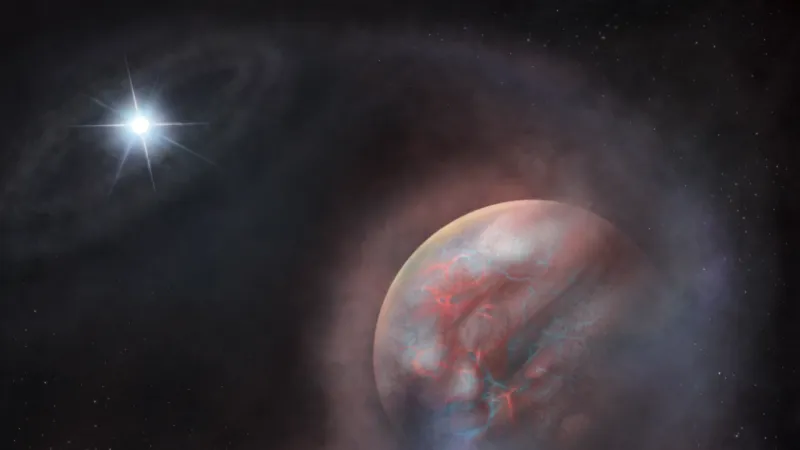
Astronomers have announced the groundbreaking discovery of a so-called "phoenix planet" that miraculously survived the catastrophic death of its host star, a finding that profoundly redefines our understanding of stellar evolution and raises critical questions about the ultimate fate of our own Solar System when the Sun reaches its demise.
The celestial body, observed in a distant star system, endured the fiery expansion of its star into a red giant, only to continue orbiting the resulting white dwarf — the dense, superheated remnant of the star's core. This unprecedented survival challenges long-held theories about planetary resilience in extreme astrophysical events.
For decades, conventional wisdom held that planets in close proximity to a dying star would either be engulfed and vaporized or ejected into the cold vacuum of interstellar space. The existence of this phoenix planet offers compelling empirical evidence against these prevailing models.
Scientists involved in the discovery emphasized that this observation provides a rare, tangible glimpse into the potential future of planets like Earth. Our Sun, approximately 4.6 billion years old, will eventually swell into a red giant, engulfing inner planets like Mercury and Venus, and possibly even Earth.
The implications for Earth are particularly poignant. While the phoenix planet's distance from its former red giant is still being precisely measured, its mere existence suggests that some planets, under specific conditions, might withstand such cosmic cataclysms. This prompts astronomers to reassess the habitable zones around white dwarfs.
Dr. Elara Vance, lead astrophysicist on the research team, noted that the discovery opens avenues for exploring how life might persist or re-emerge in post-stellar-death environments. "This planet defied expectations, offering a beacon of resilience in the universe's most violent stellar transformations," Dr. Vance stated.
The research team utilized advanced telescopic arrays and spectroscopic analysis to confirm the planet's composition and orbital characteristics around its white dwarf. Data indicated the planet likely underwent significant atmospheric stripping but retained its core structure.
This significant astronomical event follows other recent breakthroughs in understanding stellar remnants, such as when researchers, employing the advanced capabilities of the James Webb Space Telescope, uncovered the smallest brown dwarfs, twice Jupiters mass, further expanding our knowledge of substellar objects and planetary formation.
The identification of this phoenix planet also fuels theoretical discussions about exoplanet populations and the criteria for identifying potentially habitable worlds. Planetary science must now account for the possibility of a second generation of habitability following a star's death.
Future observations will focus on characterizing the phoenix planet's atmosphere, searching for signs of geological activity, and refining models that predict planetary survival around evolving stars. The findings could influence the search for extraterrestrial life in hitherto unexplored cosmic neighborhoods.
The discovery serves as a powerful reminder of the universe's dynamic and often unpredictable nature. It underscores the ongoing quest to unravel the cosmic dance between stars and their orbiting companions, a dance that dictates the very existence of planetary systems.
This remarkable celestial survival story offers hope, suggesting that life, or at least the conditions for it, might endure in ways previously unimaginable, even after the fiery end of a star.
Scientists globally are reviewing their theoretical frameworks to incorporate this new empirical data. The planet's survival mechanism could involve a complex interplay of orbital dynamics, initial planetary mass, and the specifics of the star's death throes.
The name "phoenix planet" itself encapsulates the essence of this discovery: a world reborn, or rather, steadfastly enduring, through the metaphorical ashes of its parent star. This moniker captures the profound astronomical implications.
This observation provides invaluable data for refining computer simulations of stellar and planetary evolution, offering a real-world test case for theoretical predictions.