Dorry Archiles
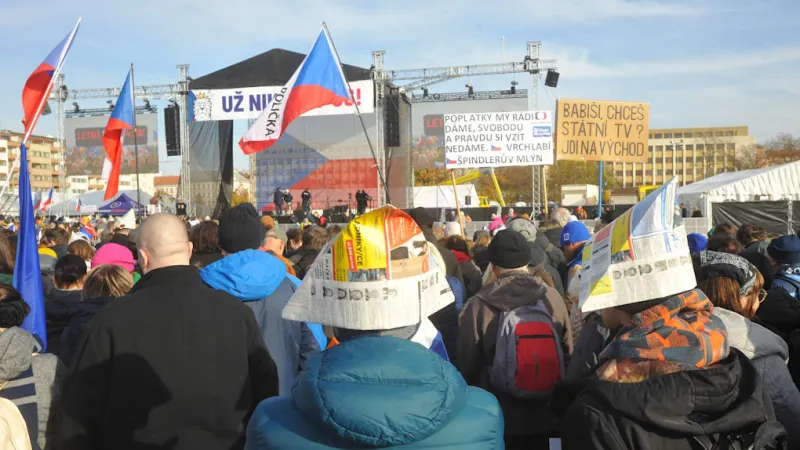
Prague—Over 200,000 Czech citizens recently converged on the capital, staging one of the largest demonstrations in years to vehemently protest proposed government reforms that critics argue threaten the fundamental independence of public broadcasting. The massive rally underscores deep public anxieties surrounding a plan to shift the financing of public media outlets directly to the state budget, a move opponents fear would inevitably compromise editorial autonomy.
The contentious legislative proposal, championed by the ruling coalition, seeks to overhaul the financial model for Czech public radio and television. Instead of relying on a dedicated license fee, the government intends to fund these vital institutions primarily through direct allocations from the national treasury. Proponents of the reform cite modernization and equitable distribution of financial burdens as key objectives.
However, critics, including journalists, civil society groups, and opposition political parties, contend that this shift would render public broadcasters vulnerable to political pressure. They warn that such a direct financial umbilical cord to the state could be exploited by any government to manipulate news coverage, silence dissenting voices, or promote a particular agenda, thereby eroding the crucial role of independent media in a democratic society.
The streets of Prague echoed with chants and placards bearing messages such as Hands off the media, reflecting a widespread sentiment that the government's initiative represents an unwelcome encroachment on journalistic freedom. Organizers of the demonstration emphasized the historical significance of robust, autonomous media in the post-communist Czech Republic, a period when independent reporting became a cornerstone of its democratic transition.
Indeed, the fight for Czech media independence has been a recurring theme in the nation's contemporary history. Memories of state-controlled media under communist rule remain potent, fueling public skepticism toward any governmental action perceived as curtailing journalistic freedom. This historical context imbues the current protests with a particular urgency and resonance among various segments of the populace.
Government officials, while acknowledging public concerns, have maintained that the reforms are not designed to undermine media independence but rather to ensure financial stability and modernize the public broadcasting system. They argue that the current license fee model is outdated and inefficient, failing to adequately address the evolving media landscape and consumption habits of citizens.
Opposition leaders, however, remain unconvinced. They dismiss the government's justifications as a pretext for gaining greater control over information dissemination. "This is a direct assault on the Fourth Estate," declared one prominent opposition lawmaker during the rally, accusing the government of attempting to muzzle critical reporting ahead of upcoming elections.
The controversy has ignited a fervent national debate about the role of media in a democratic state and the delicate balance between government oversight and editorial freedom. Public trust in institutions is often linked to the perceived objectivity of news sources, and any move that jeopardizes this objectivity could have long-term consequences for societal cohesion and informed public discourse.
Concerns about governmental influence over public broadcasters are not unique to the Czech Republic. Across Europe, similar debates periodically surface, as witnessed in Italy, where public figures continue to resist political pressures on national broadcasters. For instance, Richetti firmly rejected a right-wing Rai presidency, citing opposition duty in a situation reminiscent of the broader struggles for media autonomy.
Analysts suggest that the scale of the protest could force the government to reconsider elements of its proposed legislation or at least engage in more substantive dialogue with stakeholders. However, the ruling coalition appears determined to push through its agenda, setting the stage for a prolonged political battle over the future of Czech media independence.
The sheer number of participants, estimated at more000, signifies a powerful public rejection of the proposed changes. Such widespread mobilization often serves as a critical barometer of public sentiment, sending a clear message to lawmakers that fundamental democratic principles are not to be trifled with.
The protests also highlight a growing polarization within Czech society regarding the direction of the country's democratic institutions. The government's handling of the media reform debate could have significant political fallout, potentially eroding its support base and galvanizing the opposition ahead of future electoral contests.