 Angela Stefani
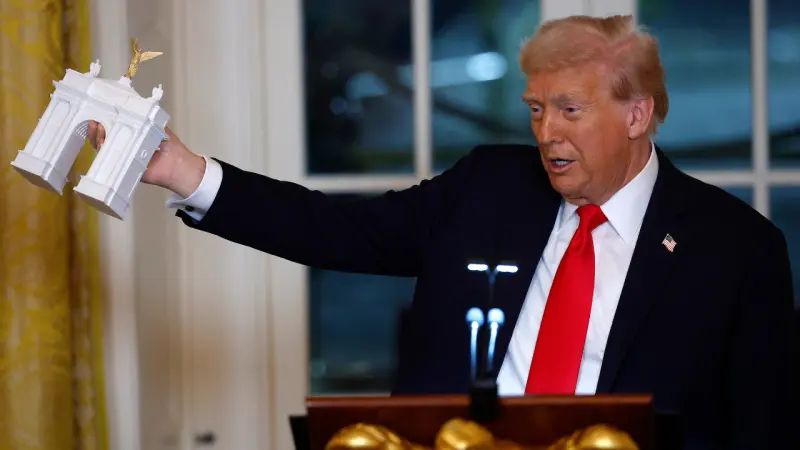
WASHINGTON — President Donald Trump announced today that official plans have been filed for the construction of a massive triumphal arch in Washington D.C., a project he envisions as a permanent monument to American greatness and a testament to his administration's legacy.
The audacious proposal, revealed via a White House statement and subsequent remarks by President Trump, signals an unprecedented architectural undertaking aimed at reshaping the capital's monumental landscape. Details surrounding the initiative, which has been in conceptual stages for months, are now beginning to emerge through regulatory channels.
During a press briefing, President Trump articulated his vision for the arch, stating it would symbolize enduring national strength and commemorate pivotal moments in American history and future aspirations. He emphasized its role as a beacon of patriotic pride and a destination for both citizens and international visitors.
While a precise location remains subject to various approvals, sources familiar with the filings suggest potential sites include prominent federal land parcels near the National Mall or along major arteries leading into the city. Initial conceptual sketches reportedly depict a structure of significant scale, echoing classical European designs but with distinctive American motifs.
The projected cost for such an ambitious endeavor is estimated to run into hundreds of millions, possibly billions, of dollars. Funding mechanisms are expected to involve a mix of federal appropriations, private donations, and potentially a national fundraising campaign, according to unnamed administration officials.
The announcement immediately drew robust support from conservative groups and many of the President's constituents, who hailed it as a bold assertion of national identity and a fitting tribute to a leader they believe has championed American exceptionalism. They see it as a powerful, tangible symbol of national achievement.
Conversely, opposition mounted swiftly from Democratic lawmakers and urban planning experts. Critics questioned the necessity and timing of such a project, especially amidst other pressing national priorities. Concerns over environmental impact, historical preservation, and the sheer expense were prominently raised.
Architectural historians and urban designers expressed reservations about potential aesthetic conflicts with existing iconic structures in Washington D.C. Many argued that the capital's carefully curated monumental core might be compromised by an imposing new addition without extensive public discourse and expert consensus.
Triumphal arches have historically served as symbols of military victory or national pride, dating back to ancient Rome. While the United States has numerous monuments, a structure of this specific scale and intended symbolic grandeur is a departure from modern American monument building conventions.
The filing of plans for a huge triumphal arch in Washington initiates a complex bureaucratic process involving numerous federal agencies, including the National Capital Planning Commission and the Commission of Fine Arts. These bodies will review the proposal for its impact on the urban landscape, historical integrity, and feasibility, setting the stage for extensive public hearings and potential modifications.
President Trump remains steadfast in his commitment to the project, viewing it as a capstone to his political career and a lasting architectural legacy. He reiterated his belief that "America deserves monuments that reflect its unparalleled stature on the world stage," according to his recent public remarks.
Beyond its architectural merits, the proposed arch is poised to ignite a broader national conversation about public art, national symbolism, and the role of presidential legacies in shaping the physical landscape of the capital. Its realization, or rejection, will undoubtedly leave a significant mark on the nation's political and cultural discourse.