 Chris Robert
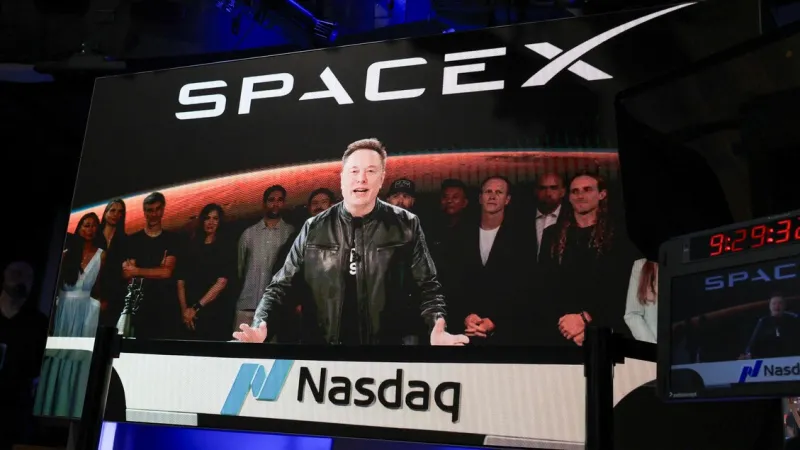
SpaceX made a historic debut on Wall Street this week, witnessing its shares skyrocket by an astounding 30% and simultaneously propelling its visionary founder, Elon Musk, to the extraordinary status of the world's first trillionaire. The private aerospace firm, long a disruptor in the space industry, officially entered the public market with a robust performance that underscored investor confidence in its ambitious plans to extend humanity's reach beyond Earth.
The impressive surge in SpaceX's valuation immediately following its initial public offering on Thursday sent ripples through global financial markets. Analysts attribute the overwhelming investor enthusiasm to the company's proven track record in rocket launches, satellite internet services through Starlink, and its forward-looking projects aimed at interstellar travel. This initial public offering stands as a landmark event, redefining the potential for private space ventures in the modern economy.
Musk's personal net worth, already substantial, crossed the trillion-dollar threshold following the dramatic market performance. This financial milestone not only solidifies his position as the wealthiest individual on the planet but also highlights the immense commercial value now ascribed to the burgeoning space economy. The achievement marks a new era of wealth accumulation driven by technological innovation and audacious entrepreneurial spirit.
Despite the current meteoric success, Musk previously harbored significant doubts about SpaceX's viability. He once recounted his early assessments of the company's prospects, revealing a profound sense of uncertainty during its foundational years. Such candid reflections provide a stark contrast to the firm's current standing as a dominant force in aerospace.
In a previous statement, Musk acknowledged the precarious early days. He said, "I gave the company less than a 10% chance of success. I thought it would fail." This admission underscores the sheer tenacity and relentless pursuit of innovation required to overcome such formidable odds and establish a company that now commands such a staggering market capitalization.
Looking ahead, Musk remains steadfast in his long-term objectives for humanity's expansion into the cosmos. Speaking at an investor conference following the market debut, he passionately articulated SpaceX's ultimate mission. He stated, "We want to take you to the Moon, to Mars and beyond," reinforcing the company's commitment to making interplanetary travel a reality.
This vision encompasses not only sending humans to the lunar surface and establishing a permanent presence on Mars but also developing technologies for even more distant space exploration. The capital raised from the Wall Street debut is expected to significantly bolster funding for these monumental endeavors, accelerating research and development into reusable rocket technology and advanced propulsion systems.
The successful market launch of SpaceX reverberates across the aerospace sector, signaling a shift from government-led space initiatives to a more dynamic, privately funded model. Competitors and established aerospace giants are closely observing SpaceX's trajectory, contemplating the implications for future investment strategies and technological advancements within the industry.
Financial experts predict that the robust performance of SpaceX on the stock exchange could encourage other private space companies to consider similar public offerings. This trend could democratize access to investment in space exploration, drawing in a broader base of capital to fuel innovation and expand the frontier of human endeavor.
The journey to the Moon and Mars, as envisioned by Musk, presents unprecedented engineering, logistical, and financial challenges. Yet, the initial public offering has provided a substantial financial springboard, demonstrating that global investors are increasingly willing to back ventures that push the boundaries of science and technology, even those with exceptionally long time horizons and inherent risks.