 Dodi Irawan
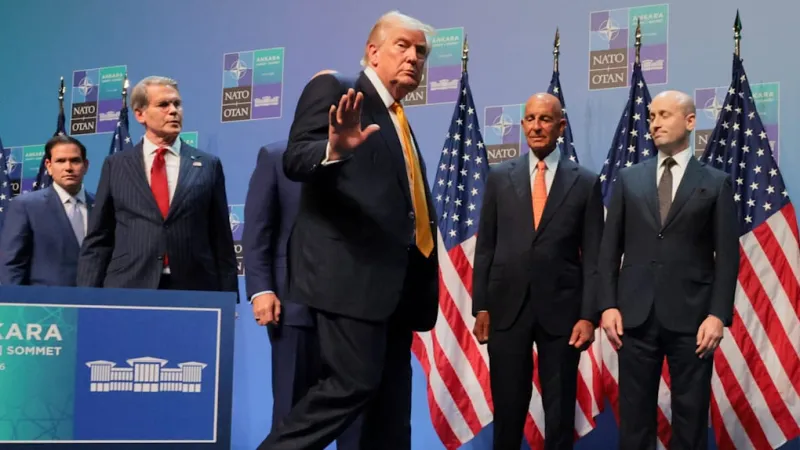
President Donald Trump sparked renewed debate during the recent NATO summit in Ankara by implying that the future presence of American troops in Europe could hinge on the ongoing dispute surrounding Greenland. Speaking to reporters on the sidelines of the high-stakes gathering, President Trump offered a deliberately ambiguous response when pressed on the number of US personnel slated to remain on the continent, tying the matter to the contested Arctic territory.
The surprising declaration has immediately sent ripples through the transatlantic alliance, compelling European leaders to grapple with what appears to be a new and significant condition for continued American military commitment. This statement marks a novel dimension to the perennial discussions about burden-sharing and the strategic positioning of forces within the North Atlantic Treaty Organization.
The dispute over Greenland, a self-governing Danish territory, resurfaced prominently in international discourse following President Trump's past expressions of interest in acquiring the vast island. While Denmark firmly rejected any sale, the issue has remained a subtle undercurrent in US-European relations, particularly concerning geopolitical influence in the Arctic.
President Trump's comments came during a pivotal moment at the Ankara summit, an event intended to reinforce unity and address pressing global security challenges. Instead, the focus has abruptly shifted to this unexpected linkage between troop deployments and the remote Arctic landmass. Such declarations have become characteristic of President Trump's approach to foreign policy, often challenging established norms, as seen in Trump Threatens Allies, Then Affirms NATO Unity Amidst Tensions.
European nations have long relied on a substantial US military presence as a cornerstone of their collective defense, especially in light of evolving security landscapes in Eastern Europe and beyond. Any significant reduction or conditional withdrawal could necessitate a fundamental reassessment of their own defense strategies and resource allocation.
The exact nature of President Trump's condition remains undefined, leaving room for speculation regarding whether it pertains to specific concessions, a change in Greenland's status, or broader cooperation on Arctic policies. His previous dealings with allies have demonstrated a willingness to tie unrelated issues to security agreements.
Analysts suggest that this strategic ambiguity might serve multiple purposes for the US administration. It could be an attempt to leverage American military presence for other geopolitical aims, to force allies to contribute more significantly to shared defense, or to advance specific US interests in the Arctic region, which holds increasing strategic importance due to climate change and new shipping routes.
The Greenland question first gained international prominence a few years ago when reports emerged of President Trump's serious inquiry into purchasing the territory. Danish officials promptly and unequivocally dismissed the idea as absurd, leading to a brief diplomatic spat that highlighted the unique status of Greenland and the complexities of sovereign territory.
Since then, the Arctic region has continued to draw global attention, not just for its mineral wealth and strategic location but also as a new arena for great power competition. Both the United States and Russia, along with other nations, have amplified their military and economic activities in the High North.
NATO, in its broader strategic calculus, has also begun to place greater emphasis on the Arctic, recognizing its critical role in global security and trade. This renewed focus makes President Trump's comments particularly pertinent, framing the future of European defense within a much wider geopolitical context.
The implications of President Trump's statement extend beyond immediate troop numbers, potentially affecting long-term defense planning, joint exercises, and the overall cohesion of the alliance. It introduces an element of uncertainty that alliance leaders will undoubtedly scrutinize in the coming weeks and months.
Many European diplomats and defense officials are likely analyzing the statement for clues about the administration's strategic priorities. The question now is how seriously the condition should be taken and what steps, if any, European nations might consider in response to this novel challenge.
This development underscores President Trump's consistent reevaluation of traditional alliances and his readiness to link seemingly disparate policy areas. His past pronouncements on NATO have frequently stirred debate before concluding with affirmations of the alliance's value. For instance, after moments of tension, President Trump has previously hailed NATO unity, citing what he called “incredible love” among leaders, as reported in Trump Hails NATO Unity, Cites Incredible Love Among Leaders.
The White House has yet to issue a clarifying statement on the President's remarks, leaving the interpretation open. This deliberate vagueness often serves to keep adversaries and allies alike guessing, maintaining a degree of diplomatic flexibility.
As the Ankara summit concludes, the Greenland-Europe troop linkage will likely dominate post-summit analyses and bilateral discussions. Alliance members will be keen to understand the full scope of President Trump's expectations and how these new conditions might reshape the transatlantic bond.
The situation highlights the delicate balance of power and influence within NATO, where the United States remains the primary military contributor. The alliance's adaptability to such evolving demands will be tested once more.
Whether this is a negotiating tactic or a firm policy shift, it signals a significant evolution in US-European defense relations under President Trump. The response from Denmark, which holds sovereignty over Greenland, will also be critical as this geopolitical chess match unfolds.
The overarching narrative from Ankara, initially focused on collective security threats, has now been significantly colored by this unexpected and conditional proposal, ensuring that the Greenland issue will remain a prominent feature in international political discourse.