Gabriella
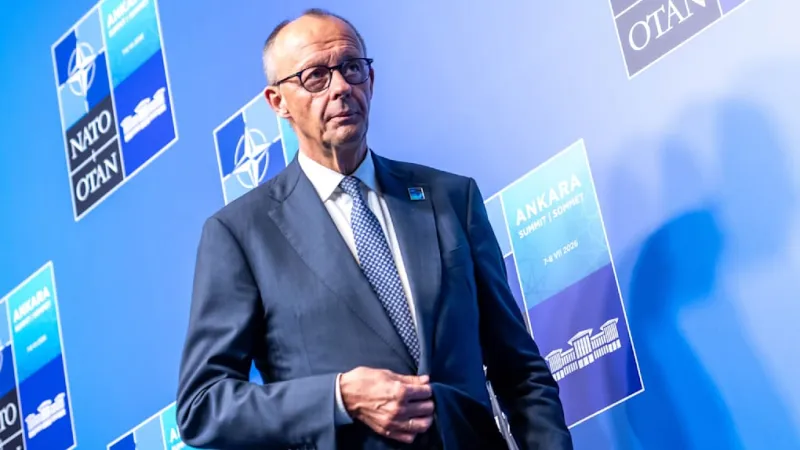
Ankara – President Donald Trump delivered unexpectedly conciliatory remarks at the conclusion of the recent NATO Summit, signaling a potential shift in his approach to the alliance after earlier criticisms. This diplomatic pivot, which Chancellor Olaf Scholz described as embodying a “Spirit of Ankara” and fostering new alliance dynamism, included a notable private statement from President Trump, reportedly relayed by German opposition leader Friedrich Merz, raising questions about the alliance’s unified front against Russian aggression.
President Trump, whose previous pronouncements often challenged the very foundation of the transatlantic military alliance, adopted a markedly different tone during the closing sessions. His final address eschewed the sharp criticisms leveled earlier in the summit, opting instead for language emphasizing unity and collective purpose among member states.
Friedrich Merz, leader of Germany's Christian Democratic Union, later recounted a particularly “remarkable” statement from President Trump made during a confidential discussion. While Merz did not disclose the precise wording, the context suggests a surprising or positive affirmation of NATO's value, departing from the President's more publicly skeptical posture. Such private reassurances carry significant weight among European partners.
German Chancellor Olaf Scholz seized upon this shift, characterizing the summit's outcome as generating a “Spirit of Ankara.” He elaborated that this fresh dynamism within the alliance was crucial for its ongoing relevance and capacity to address contemporary security threats. The Chancellor underscored the necessity of robust multilateral cooperation.
The primary strategic question remains whether this renewed spirit and President Trump's softened rhetoric are sufficient to unequivocally deter Russian aggression. With ongoing geopolitical tensions and the continued conflict in Ukraine, NATO's credibility as a united defensive bulwark is under constant scrutiny.
Just days prior, President Trump had notably unleashed fury at NATO members, targeting countries like Iran and Spain during initial summit discussions. His declarations had caused considerable consternation among allies, prompting concerns about the alliance's future cohesion. This earlier stance directly contrasted with his concluding remarks, highlighting a significant diplomatic shift. Trump Unleashes Fury at NATO, Targets Iran and Spain at Ankara Summit.
Despite past controversies, the North Atlantic Treaty Organization continues to serve as the cornerstone of Euro-Atlantic security. Its Article 5 collective defense clause remains central to its mission, pledging mutual defense against any external attack. The Ankara summit aimed to reinforce this fundamental principle.
European leaders, who had braced for a potentially contentious summit, reportedly viewed President Trump's concluding remarks with a mix of cautious optimism and relief. Many had openly expressed apprehension regarding the US commitment to the alliance, particularly in the face of escalating global instability.
President Trump's relationship with NATO has been historically complex. Throughout his terms, he has frequently criticized member states for insufficient defense spending, labeling some as “delinquent” in their contributions. This consistent pressure has often led to periods of uncertainty within the alliance.
This apparent shift in diplomatic posture, even if primarily rhetorical, could signal a more stable period for transatlantic relations. It could potentially alleviate some of the strategic anxieties that have plagued the alliance in recent years, particularly concerning the reliability of American leadership.
Observers suggest that while one summit's conclusion cannot erase years of skepticism, President Trump's conciliatory tone at Ankara provides a critical opportunity for NATO members to rebuild trust and fortify their collective defense strategy. The alliance now faces the challenge of translating rhetoric into concrete, unified action.
Nevertheless, the underlying challenges for NATO persist. The need for increased defense spending, modernized military capabilities, and a coherent strategy against evolving threats remain paramount. The “Spirit of Ankara” will be tested by the ongoing realities of global geopolitics.