 Dorry Archiles
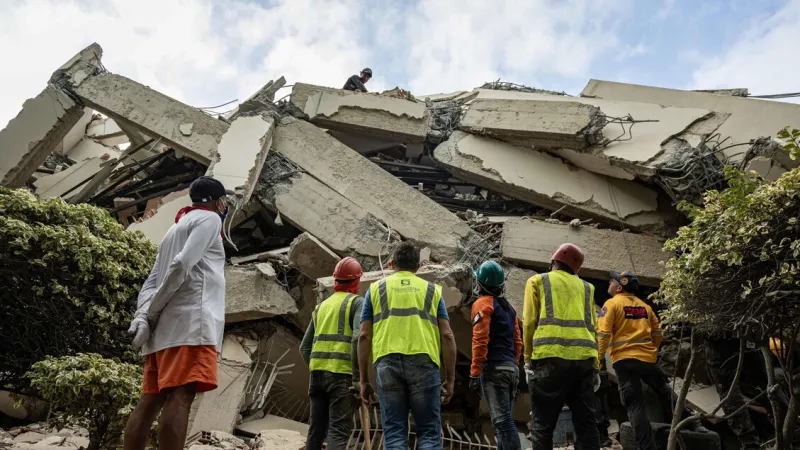
CARACAS, Venezuela – An 11-year-old boy has been miraculously pulled alive from the rubble of a collapsed building, three days after a series of powerful earthquakes devastated coastal regions of Venezuela. His dramatic rescue offers a crucial beacon of hope amidst the widespread destruction and mounting death toll, a sentiment echoed by President Carolina Rodriguez who announced the boy's survival to the nation.
The boy, whose identity has not been released for privacy reasons, was discovered by search and rescue teams tirelessly sifting through debris in a particularly hard-hit urban center. His survival against such formidable odds has been hailed as a testament to the resilience of the human spirit and the unwavering efforts of emergency responders.
President Rodriguez, addressing a somber nation, shared the news during a press briefing late Tuesday. "Every life is a source of hope," she stated, her voice conveying both gravity and profound relief. Her announcement brought a rare moment of joy to a country grappling with immense loss and the daunting task of recovery.
The seismic events, which began early Saturday morning, registered magnitudes as high as 7.3, unleashing widespread devastation across several Venezuelan states. Infrastructure, including homes, schools, and hospitals, suffered catastrophic damage, leaving tens of thousands displaced and countless others in urgent need of assistance.
International aid organizations and rescue specialists have converged on Venezuela, deploying advanced equipment and trained personnel to assist local authorities. These multinational teams have been working around the clock, battling aftershocks and challenging conditions to locate survivors. The relentless search for individuals still trapped under debris remains a critical priority.
While this rescue provides a glimmer of optimism, the overall picture remains grim. The nation continues to mourn numerous victims, including individuals like the Sicilian Francesca, who was found dead in the quake rubble, a stark reminder of the immense human cost. Recovery efforts are expected to be protracted and incredibly costly.
President Rodriguez's administration has declared a national state of emergency, mobilizing military and civilian resources for extensive relief operations. Humanitarian corridors have been established to facilitate the urgent delivery of essential supplies, including food, water, and medical aid, to the most affected areas, many of which remain difficult to access.
Nations worldwide have pledged substantial support, with emergency shipments already arriving at Venezuelan ports and airports. Search and rescue teams from various countries, equipped with specialized canine units and sophisticated listening devices, are concentrating their efforts in zones where the likelihood of finding additional survivors is considered highest.
The challenge now extends far beyond immediate rescue to providing adequate shelter, comprehensive medical care, and critical psychological support to the thousands who have lost everything. Concerns are also rising over the potential for outbreaks of disease in displaced communities lacking adequate sanitation and clean water.
Venezuela sits near the convergence of the Caribbean and South American tectonic plates, making it inherently prone to significant seismic activity. Geologists have indicated that the recent tremors were a complex series of events, exacerbating the destruction across already vulnerable regions. Satellite imagery has already begun to expose the full scale of the devastation in coastal cities, painting a stark, sobering picture of the catastrophe.
Across Venezuela, the public remains glued to news updates, alternating between profound grief for the deceased and the desperate hope for more survivors. The miraculous rescue of the 11-year-old has briefly united the nation in a rare moment of shared relief and renewed determination to overcome the unprecedented tragedy.
Experts predict that rebuilding damaged infrastructure and rehabilitating shattered communities will take years, requiring substantial international investment and sustained national effort. The long-term psychological impact on survivors, particularly children, and the dedicated relief workers also represents a significant and enduring public health challenge for the country.