 Angela Stefani
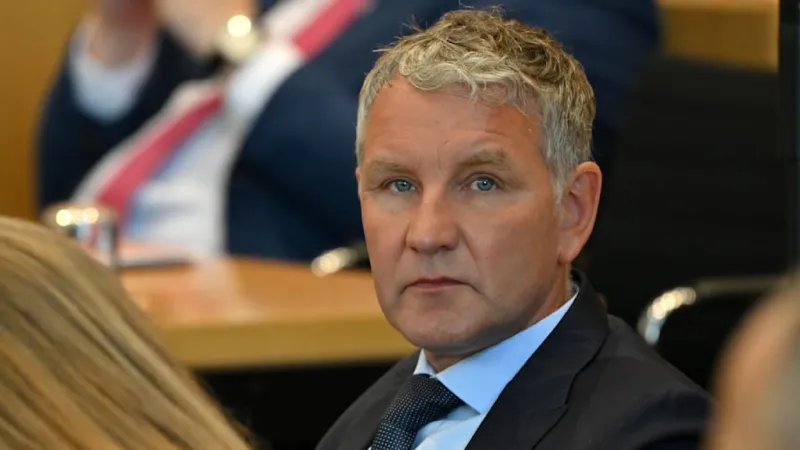
BERLIN – Björn Höcke, the influential leader of the Alternative for Germany (AfD) in Thuringia, has issued a definitive call for his party to maintain a strategic distance from the Christian Democratic Union (CDU), signaling a significant recalibration of the nationalist party’s approach to potential alliances within the German political landscape. This pronouncement reverses his prior indications of possible collaboration following past state elections, now asserting that the absence of such cooperation was the correct course.
Höcke’s current stance marks a notable departure from his earlier public statements, where he had explored the feasibility of working with the CDU, particularly in the aftermath of regional electoral successes. This earlier openness had stirred considerable debate and concern across Germany's established political spectrum.
The shift reflects a hardening of the AfD’s position, suggesting an internal party consensus or a deliberate strategic pivot by Höcke, who remains a dominant figure within the party's more radical wing. This move aims to reinforce the AfD’s identity as a distinct opposition force, untainted by association with what it often labels as “establishment parties.”
For years, the mainstream parties, including the CDU, have upheld a stringent policy of non-cooperation with the AfD, citing fundamental ideological differences and concerns over the AfD's rhetoric and policies. This so-called cordon sanitaire has largely isolated the AfD at both federal and state levels.
Höcke’s declaration now effectively cements this separation from the AfD’s side, removing any ambiguity about his faction's willingness to engage in coalition talks. It indicates a strategy focused on further electoral gains through an uncompromised, opposition-oriented platform, rather than seeking immediate governing roles through alliances.
Observers suggest this move could be aimed at consolidating the AfD’s base, which often views any rapprochement with mainstream parties as a betrayal of the party's founding principles. Such a stance might appeal to voters who feel disillusioned with traditional politics and seek a clear alternative.
The CDU, under its current leadership, has consistently reaffirmed its commitment to democratic principles and rejection of extremism, thereby precluding any formal cooperation with the AfD. Höcke’s statements provide little room for altering this established position, as the AfD itself now champions the distance.
The political climate in 2026 Germany sees continued debate surrounding the rise of populist movements. The AfD's electoral performance, particularly in eastern German states like Thuringia, has repeatedly challenged the stability of coalition governments and forced mainstream parties into difficult political maneuvers.
This directive from Höcke could intensify the political polarization in Germany, making it even more challenging to form stable regional governments in states where the AfD enjoys strong public support. It may compel other parties to seek broader, more ideologically diverse coalitions to circumvent the AfD's influence.
The strategic implication for the AfD is multifaceted. By rejecting overtures to the CDU, Höcke aims to present the AfD as the sole genuine alternative, distinct from the political center. This approach could either galvanize its core supporters or alienate more moderate voters seeking pragmatic solutions.
Historically, the AfD has seen internal debates regarding its future path: whether to maintain a purely opposition role or to pursue governmental responsibility. Höcke's latest pronouncement clearly steers the party towards the former, at least concerning the CDU.
This political maneuvering occurs amidst broader discussions about the health of German democracy and the challenges posed by parties on the far-right and far-left. Mainstream parties continue to grapple with how to respond to the AfD's growing electoral footprint without legitimizing its more controversial aspects.
Analysts will closely watch how Höcke’s demand resonates within the broader AfD apparatus. While he holds significant sway, particularly in the eastern states, the party has experienced internal factions with varying strategic outlooks.
The implications extend beyond Thuringia, potentially influencing federal elections and the overall direction of conservative politics in Germany. A clear break from even the idea of cooperation with the CDU might force the CDU to further define its own conservative identity.
This development underscores a deepening ideological chasm within German politics, where the boundaries between acceptable political discourse and perceived extremism are continually tested and redefined by prominent figures like Björn Höcke.