 Chris Robert
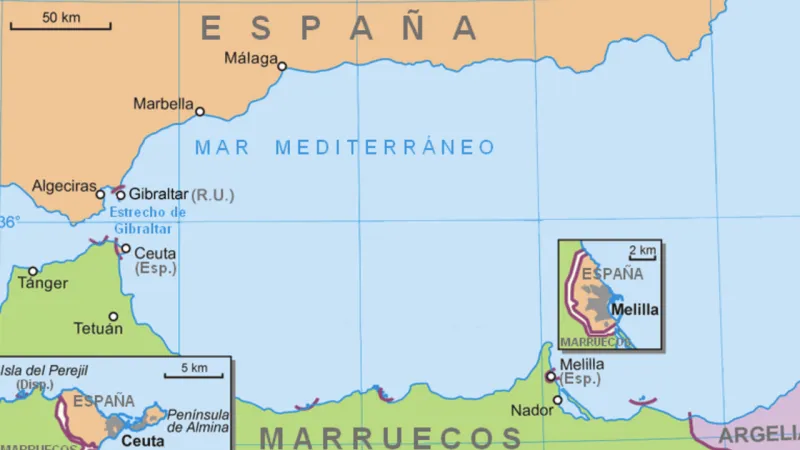
CEUTA, SPAIN – The fortified perimeters encircling the Spanish enclaves of Ceuta and Melilla, situated on North Africa's Mediterranean coast, represent the European Union's sole land borders with the African continent. These intricate barrier systems, a testament to geopolitical complexities, exist primarily to regulate the flow of irregular migration and have become focal points for international debate on border security, human rights, and the future of Europe's external frontiers.
Historically, Ceuta and Melilla have been under Spanish sovereignty for centuries, predating Spain's membership in the European Union. Their strategic location has always made them crucial outposts, but it was with the advent of modern mass migration that their border infrastructure evolved into the formidable structures seen today.
What began as simple fences has transformed into a complex network comprising multiple parallel fences, often reaching heights of 20 feet or more, topped with razor wire or anti-climb mesh. Advanced surveillance technologies, including thermal cameras, motion sensors, and patrol roads, further augment these physical deterrents.
The primary objective of the Ceuta and Melilla barriers is unambiguous: to prevent unauthorized entry into Spanish and, by extension, European Union territory. For countless individuals from sub-Saharan Africa and other regions, these enclaves represent a perceived gateway to a better life, making the barriers a monumental challenge in their perilous journeys.
Despite the formidable defenses, desperate attempts to cross the barriers remain a recurrent phenomenon. Migrants often arrive in large groups, attempting to overwhelm border defenses in coordinated efforts, sometimes referred to as “saltos” or jumps, with tragic consequences.
These crossings frequently result in severe injuries, both from falls and contact with the razor wire. Human rights organizations and aid groups consistently highlight the significant humanitarian toll, including fatalities, as documented by incidents such as the overwhelming of the Ceuta border where 49,000 migrants entered and 18 died amid clashes. More recently, Ceuta was overwhelmed by 60,000 migrants, leading to 24 deaths and igniting a diplomatic row.
From Spain's perspective, maintaining the integrity of these borders is a matter of national sovereignty and security. The Spanish government, often citing its commitment to managing orderly migration, invests significant resources in strengthening and patrolling these frontiers, viewing them as critical to the broader EU migration framework.
The European Union, recognizing these as its external land borders, provides substantial financial and logistical support to Spain for border management in Ceuta and Melilla. This underscores the shared responsibility within the bloc for securing its periphery against irregular flows.
Morocco, which borders both enclaves, plays a complex and sometimes controversial role. While often cooperating with Spain on migration control, it has also been accused of periodically relaxing its border surveillance, particularly during diplomatic tensions with Madrid. This delicate balance of cooperation and friction defines much of the region's migration dynamics.
International bodies and human rights advocates have frequently criticized the design and operational aspects of the Ceuta and Melilla barriers, particularly the use of razor wire and the legality of immediate expulsions or “hot returns.” They advocate for more humane asylum processing and greater transparency at the border.
The persistent migration pressure, exacerbated by geopolitical instability and economic disparities in Africa, ensures that these borders remain a constant flashpoint. Despite upgrades and increased surveillance, the allure of Europe continues to draw individuals to these precarious crossing points, as highlighted when Ceuta came under siege with 60,000 migrants, straining Spain's resources.
The debate over the Ceuta and Melilla barriers is a microcosm of wider European discussions on migration policy, national security, and international humanitarian obligations. As 2026 progresses, policymakers continue to grapple with how to balance robust border control with the imperative to uphold human dignity at these unique European outposts on African soil.
Alternative approaches, including strengthening diplomatic ties and aid programs with African nations, are continually proposed as longer-term solutions to address the root causes of migration, rather than solely relying on physical barriers. However, the immediate challenge of managing these volatile frontiers persists, making the Ceuta and Melilla barriers enduring symbols of Europe's complex relationship with its African neighbors.