Gabriella
BERLIN – The German Interior Ministers Conference has issued a significant recommendation, urging all citizens to prepare emergency survival backpacks capable of sustaining them for a minimum of three days. This directive underscores a proactive approach to national security and individual resilience amidst potential crises.
The initiative, championed by the conference, aims to bolster public preparedness, ensuring households can manage essential needs independently should unforeseen events disrupt public services or infrastructure. The focus is on self-reliance during the critical initial phase of an emergency.
Albrecht Broemme, the former president of the Federal Agency for Technical Relief (THW), emphasized the profound impact such individual preparedness could have on collective safety. “If everyone could hold out for three days, that would be a great help,” Broemme stated, highlighting the relief this would offer emergency services in overwhelmed situations.
This recommendation arrives as governments worldwide increasingly review and update their civil defense strategies in response to a complex global landscape characterized by natural disasters, geopolitical tensions, and potential cyber threats. Germany's move aligns with a broader international trend towards empowering citizens with practical tools for self-protection.
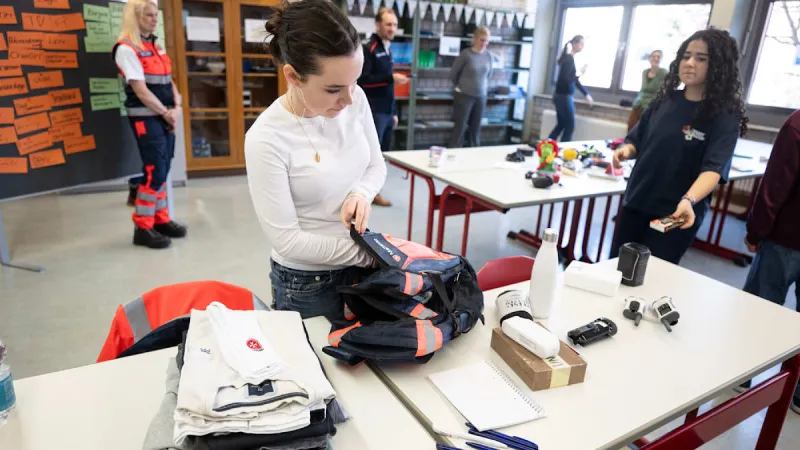
The suggested emergency backpack, often termed a “go-bag” or “bug-out bag,” is intended to contain crucial supplies. These typically include non-perishable food items, potable water, essential medications, a first-aid kit, a flashlight with extra batteries, a crank radio, important documents, and cash.
The specific contents are designed to address immediate needs for survival, communication, and self-care in scenarios where access to typical amenities or emergency assistance might be temporarily unavailable. Authorities advise tailoring the kit to individual family needs, including provisions for infants, elderly relatives, or pets.
The concept of individual emergency preparedness is not new in Germany, with public awareness campaigns having intermittently promoted such measures. However, the explicit and unified recommendation from the Interior Ministers Conference signals a renewed and more urgent emphasis on this aspect of national resilience.
Experts stress that beyond merely assembling a kit, understanding its purpose and regularly checking its contents are equally vital. Perishable items, medications, and document copies should be updated periodically to ensure their efficacy and relevance.
Broemme also suggested that a well-prepared citizenry allows emergency responders to concentrate resources on those most vulnerable or in critical immediate danger, thereby optimizing overall crisis management efforts. It is a shared responsibility between government and populace.
The German government has long maintained various emergency response protocols and infrastructure, but the focus on individual household preparedness acknowledges the distributed nature of modern threats. Every household contributing to its own immediate safety frees up public resources during widespread disruptions.
While the recommendation is designed to cover a broad spectrum of potential crises, from severe weather events and power outages to more complex civil defense scenarios, it primarily encourages a mindset of readiness rather than fear. The goal is empowerment through proactive planning.
Citizens are advised to keep their emergency kits in an easily accessible location within their homes, ensuring they can be retrieved quickly during an evacuation or a sudden need for self-sufficiency. This accessibility is a key component of effective preparedness.
In essence, the German Interior Ministers Conference is advocating for a societal shift towards greater personal responsibility in times of adversity, a practical measure that could significantly mitigate the impact of future emergencies on the nation’s infrastructure and its people.