 Debby Wijaya
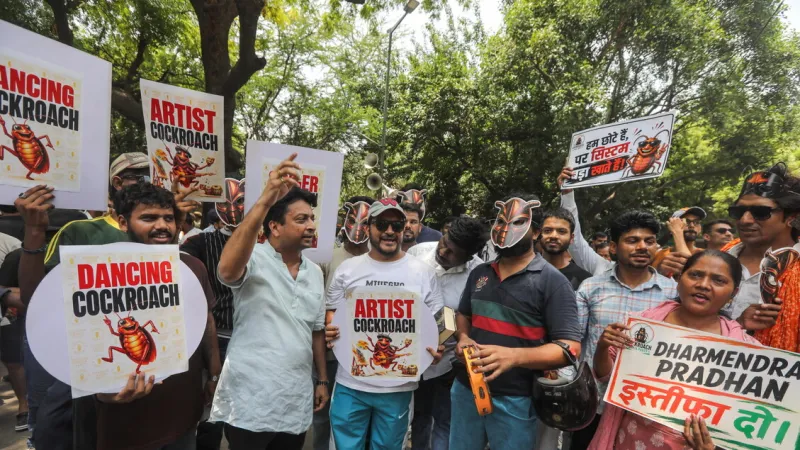
The satirical online collective, the Cockroach Party, has recently escalated its digital activism to direct street protests across various locations in India, launching a direct challenge to Prime Minister Narendra Modi's government. The group's bold demonstrations culminated in a singular demand: the immediate resignation of the nation's Education Minister. This public outcry signifies a noteworthy shift from their usual online presence to tangible political action.
The genesis of the Cockroach Party lies in India's vibrant, often fractious, online landscape, where it cultivated a following through sharp, often biting, commentary on socio-political issues. Their choice of moniker, while seemingly unconventional, serves as a potent symbol of their self-perception as an irritating, yet persistent, presence aiming to expose perceived flaws and corruption within the system.
Their recent transition to street protests underscores a growing public discontent that social media platforms alone can no longer contain. These demonstrations, though not widespread in a traditional sense, represent a vocal segment of the population unafraid to confront the ruling establishment. The move aims to amplify their message beyond digital echo chambers, compelling mainstream attention.
The demand for the Education Minister's resignation is particularly significant, touching upon a highly sensitive nerve in Indian society. Education remains a pivotal concern for millions, and any perceived governmental failures or controversies within this sector often ignite strong public reactions. The group has leveraged this sensitivity to garner support for its campaign.
While specific allegations or incidents that triggered this latest demand were not immediately detailed by the group, the overarching narrative propagated by the Cockroach Party suggests a broader critique of the government's policies and their implementation within the education system. This resonates with broader national conversations around academic standards, funding, and accessibility.
Prime Minister Narendra Modi's administration, known for its robust and often assertive response to dissent, now faces the peculiar challenge posed by this satirical entity. The government has historically demonstrated a low tolerance for public criticism, particularly from groups perceived as undermining national narratives or political stability.
The rise of groups like the Cockroach Party highlights the evolving nature of political opposition and activism in the digital age. Where traditional political parties might struggle to mobilize youth or capture public imagination, satirical collectives often succeed by employing humor, irony, and unconventional tactics to convey serious political messages.
Analysts suggest that while the immediate impact of such a group forcing a ministerial resignation might be limited, their emergence and public actions contribute to a climate of increased scrutiny and accountability. They compel a conversation, however uncomfortable, that the government might otherwise prefer to suppress or ignore.
The group's strategy appears to be one of persistent agitation, using their distinctive brand to maintain visibility and pressure. By targeting a key ministerial portfolio, they aim to expose what they perceive as systemic issues, rather than merely isolated incidents, thereby attempting to broaden the scope of their critique.
The coming weeks will likely reveal the government's approach to neutralizing or responding to this unique form of protest. Whether the satirical voice of the Cockroach Party will gain broader traction or be dismissed as a fringe element remains to be seen, but their presence on India's streets marks a compelling moment in the nation's political discourse.
The group's ability to mobilize people and articulate grievances through satire provides a fascinating case study in modern political dissent, pushing the boundaries of traditional political engagement in a powerful democracy.