 Angel Doris
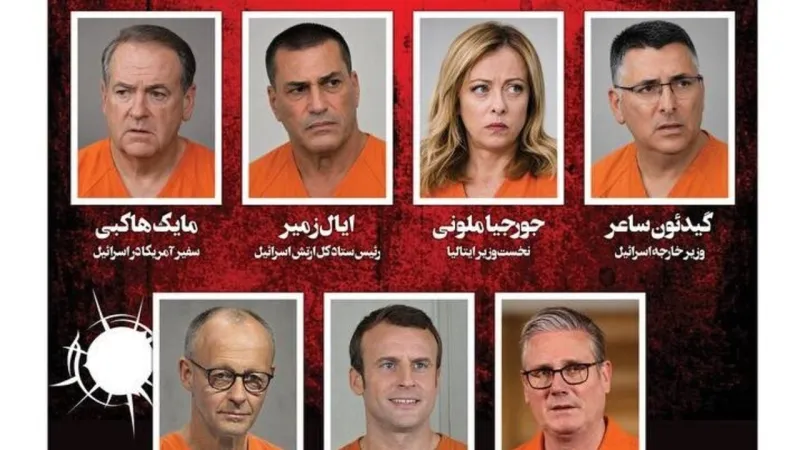
Tehran An Iranian daily has unleashed a stark provocation, featuring Italian Premier Giorgia Meloni, President Donald Trump, and Israeli Prime Minister Benjamin Netanyahu on a purported blacklist and depicting them in orange prisoner uniforms. The shocking publication explicitly accuses the three international leaders of responsibility for the death of Ayatollah Ali Khamenei, Iran's supreme leader, whose passing marks a pivotal moment in the nation's political landscape.
The controversial image, widely circulated by the Iranian newspaper, shows the leaders side-by-side, clad in the distinctive orange attire often associated with detainees. This visual broadside represents a potent and unambiguous message from elements within Iran, seeking to assign blame for a seismic shift in the Islamic Republic's leadership.
Ayatollah Ali Khamenei, who served as Iran's supreme leader for decades, wielded immense religious and political authority. His death has inevitably triggered a period of uncertainty and potential power struggles within the country, even as the succession process formally unfolds. The Iranian daily's accusation serves to externalize blame, redirecting domestic and international attention towards perceived foreign adversaries.
The inclusion of Premier Meloni on such a list is particularly noteworthy. While the United States and Israel frequently find themselves targets of Iranian rhetoric, Italy, under Meloni's conservative government, has generally maintained a more nuanced diplomatic stance, albeit one that aligns with Western allies. This development signals a potential broadening of Tehran's list of perceived enemies.
President Donald Trump's presence on the list aligns with a long history of strained relations between Washington and Tehran. His administration pursued a policy of maximum pressure against Iran, including withdrawal from the Joint Comprehensive Plan of Action (JCPOA) and reimposition of stringent sanctions. This history provides ample context for Iranian elements to link him to any perceived detriment to the Islamic Republic.
Similarly, Israeli Prime Minister Benjamin Netanyahu is a predictable target. Israel and Iran are regional arch-rivals, frequently engaged in proxy conflicts and clandestine operations. Tehran consistently views Israel as a primary antagonist, making Netanyahu's inclusion on a blacklist following Khamenei's death a clear expression of deep-seated animosity.
The act of depicting world leaders in prisoner garb is not merely symbolic; it carries a potent charge of dehumanization and a clear implication of culpability and deserving punishment. Such imagery aims to galvanize domestic support against foreign intervention and rally public opinion around a narrative of external threats.
Analysts suggest this aggressive media posture could serve multiple purposes. It might be a tactical move to deflect attention from internal dynamics surrounding Khamenei's succession, or it could be a deliberate signal of intent regarding Iran's future foreign policy direction. The timing, directly after the supreme leader's death, amplifies its significance.
This latest development comes amid persistent geopolitical tensions in the Middle East, with ongoing discussions between international powers and Iran, often mediated by other nations. The provocative publication could complicate these delicate diplomatic efforts, adding another layer of mistrust and animosity. For instance, recent reports indicate US officials engaged Iran in Oman amid escalating revenge threats, underscoring the continuous efforts to de-escalate regional friction.
The international community awaits formal responses from Rome, Washington, and Jerusalem regarding this inflammatory publication. While such accusations from Iranian media are not unprecedented, the direct linkage to the supreme leader's death and the prominent display of world leaders in prisoner uniforms elevate this incident to a serious diplomatic concern. The potential for further escalation in rhetoric or action remains a significant worry for global stability.
This event underscores the volatile nature of international relations concerning Iran and its leadership transitions. The portrayal of these leaders as criminals responsible for a highly sensitive event is a calculated move designed to send a powerful message both domestically and internationally. It sets a confrontational tone for the post-Khamenei era, signaling that hardline elements within Iran intend to maintain a defiant stance against Western powers and Israel. The repercussions of this highly charged accusation will likely unfold in the coming weeks as various governments weigh their responses.