 Angela Stefani
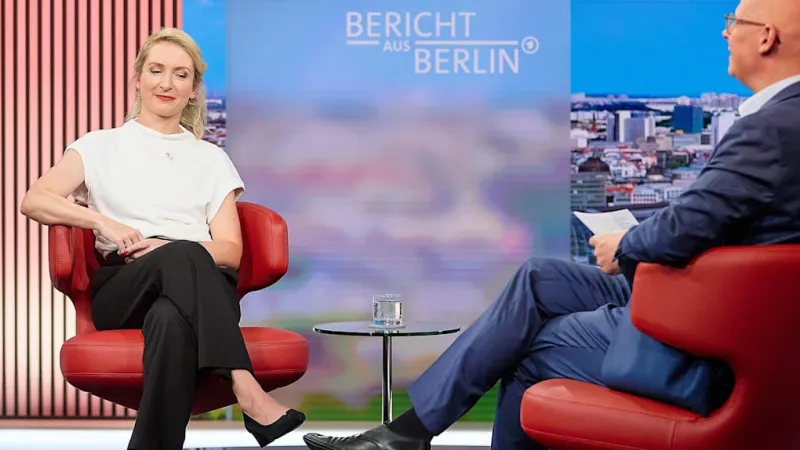
Berlin – Left Party leader Janine Schwerdtner has robustly criticized Germany's federal government for its proposed substantial social cuts and a contentious ban on expropriations, asserting the latter is unconstitutional. In a recent ARD Summer Interview, Schwerdtner declared her party's commitment to broad protest actions and robust political resistance emanating from Berlin.
Schwerdtner's strong remarks underscore a growing chasm between the Left Party's socialist principles and the federal government's fiscal policies. She characterized the planned reductions in social spending as a fundamental assault on the nation's welfare state, designed to disproportionately affect vulnerable populations.
The specific details of the proposed social cuts, which Schwerdtner termed a “Sozialkahlschlag” or social slashing, remain a focal point of public debate. Critics argue these measures could unravel decades of social progress and exacerbate economic inequalities across the country.
Central to Schwerdtner's critique is the federal government's planned ban on expropriations. This move, which would legally restrict the ability of state or municipal authorities to nationalize private assets for public good, has ignited a constitutional debate.
“The planned ban on expropriations is clearly unconstitutional,” Schwerdtner stated during the interview, challenging the government's legal standing and intentions. Her party views the right to expropriate as a critical tool for public housing, infrastructure, and ensuring social equity, especially in rapidly gentrifying urban centers like Berlin.
She pledged that the Left Party would spearhead a broad front of protest actions, mobilizing citizens and various social groups to oppose the government's agenda. These demonstrations are anticipated to gain significant traction, particularly in regions most affected by potential social service reductions.
Schwerdtner notably emphasized that political resistance would primarily originate from Berlin, a city historically known for its progressive politics and vibrant protest culture. This focus on the capital suggests an attempt to harness Berlin's unique political climate to pressure the federal administration.
Indeed, the Left Party leader alluded to a perceived apprehension within the Christian Democratic Union (CDU) regarding a potentially “red Berlin” governed by a left-leaning mayoral leadership. This sentiment, often discussed in political circles, suggests a strategic concern among conservative factions about the capital's political direction and its potential influence on national policy.
The political implications of the government's stance on social cuts and expropriation are profound, potentially straining the existing federal coalition and igniting broader public discontent. The debate over fair wages and social safety nets has also been a contentious global issue, with parallels seen in movements demanding improved conditions for workers, such as those highlighted in the article, Gig Economy Under Fire: Florence Riders Demand Fair Wages, Safer Conditions.
Constitutional scholars are closely examining the legality of the proposed expropriation ban. If enacted, it could trigger a legal battle that reaches Germany's highest courts, potentially setting a significant precedent for property rights and state intervention.
For the Left Party, this confrontation represents a crucial opportunity to reassert its relevance and galvanize its base amidst fluctuating political fortunes. By championing social welfare and challenging what it views as a conservative overreach, the party aims to position itself as the primary defender of social justice.
The federal government, in turn, faces the challenge of justifying its proposed cuts and the expropriation ban to a skeptical public. Officials argue the measures are necessary for fiscal stability and economic efficiency, though these arguments have met with considerable opposition.
The upcoming protest actions and political debates are expected to intensify, shaping the national discourse on economic policy, social welfare, and constitutional rights. The outcome could significantly influence Germany's political landscape in the years ahead.
As the nation navigates these complex issues, the rhetoric from leaders like Schwerdtner highlights the fundamental ideological cleavages that continue to define German politics in 2026. The struggle over social provisions and the extent of state power remains a central battleground.