 Dorry Archiles
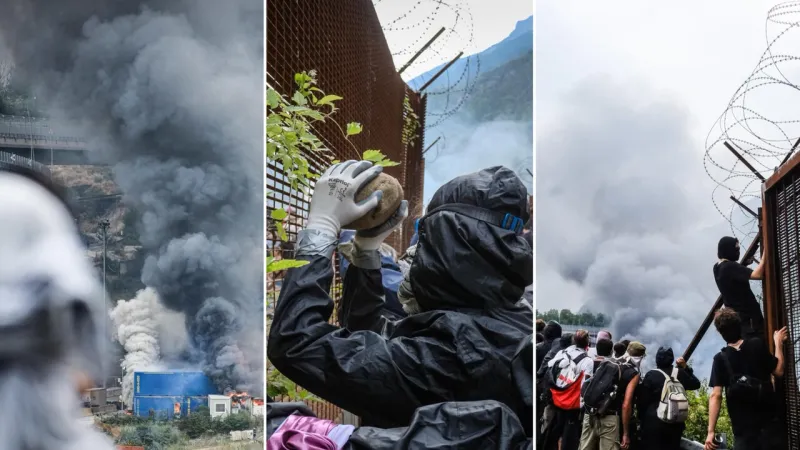
ITALY – Hundreds of masked No Tav militants launched a violent, guerrilla-style assault on high-speed rail construction sites across the nation, deploying paper bombs and tear gas in a significant escalation of the long-running conflict. The coordinated attack prompted swift condemnation from the highest levels of Italian government, with President Sergio Mattarella extending solidarity to injured agents and Prime Minister Giorgia Meloni reaffirming the state's unwavering resolve against such aggression.
The clandestine operation saw an organized group of individuals, their faces obscured, targeting critical infrastructure central to the Turin-Lyon high-speed rail (TAV) project. Security forces stationed at the perimeter were met with a barrage of projectiles, including crude explosive devices and chemical irritants, designed to disrupt and inflict damage.
Following the violent confrontation, Italian President Sergio Mattarella reportedly telephoned Interior Minister Matteo Piantedosi to convey his profound gratitude and closeness to the law enforcement agents wounded during the clashes. The call underscored the state's recognition of the risks faced by police and carabinieri in safeguarding public order and vital national projects.
Prime Minister Giorgia Meloni issued a strong condemnation of the violence, asserting unequivocally, “The violence will not break the state.” Her statement, delivered in the immediate aftermath, emphasized that such acts of aggression would not deter the government from pursuing its objectives and ensuring the safety and security of its citizens and infrastructure.
The No Tav movement, an acronym for No Treno Alta Velocita, has been a persistent force in Italian politics for decades, vehemently opposing the construction of the high-speed railway line through the Susa Valley. Proponents argue the project is essential for economic development and European connectivity, while opponents cite environmental impact, health concerns, and cost-benefit ratios.
This latest incident mirrors previous confrontations that have sporadically erupted around the construction zones. Past protests have seen significant property damage and clashes, highlighting the deep-seated opposition that often escalates beyond peaceful demonstration. For instance, in a similar vein, a violent No Tav march previously closed a highway, drawing a firm response from the government.
The tactical use of improvised explosive devices and tear gas marks a concerning intensification of the No Tav activists' methods, pushing the boundaries of protest into direct criminal acts. This shift raises alarms among security experts regarding the potential for further radicalization within elements of the movement.
Law enforcement personnel, often outnumbered, worked to repel the assault and secure the perimeters, incurring injuries in the process. Their sustained presence at the sites has been a constant necessity, reflecting the ongoing threat posed by determined factions within the protest movement.
The government's steadfast commitment to the Turin-Lyon TAV project remains undimmed, despite these persistent challenges. Official statements consistently frame the railway as a strategic asset for Italy and the broader European Union, crucial for freight and passenger transport links.
While the broader No Tav movement encompasses a wide spectrum of views, these violent episodes are typically attributed to more radicalized fringes. The challenge for authorities lies in distinguishing between legitimate protest and outright criminal activity aimed at obstructing public works through force.
President Mattarella's direct communication with the Interior Minister signals the gravity with which the head of state views attacks on state symbols and its security forces. It serves as a powerful message of institutional unity against those who resort to violence.
The economic ramifications of these disruptions are significant, with delays and increased security costs adding to the project's overall expense. Such events also cast a shadow over Italy's ability to complete major infrastructure projects without facing extreme domestic opposition.
As investigations into the specific individuals responsible for this latest assault commence, authorities are expected to employ robust measures to identify and prosecute those who engaged in violence. The goal is to reinforce that illegal actions will face the full force of the law.
This incident serves as a stark reminder of the enduring social and political divisions surrounding large-scale infrastructure developments in Italy, and the constant vigilance required to maintain public order in the face of determined, sometimes violent, opposition groups.