 Robert Andrison
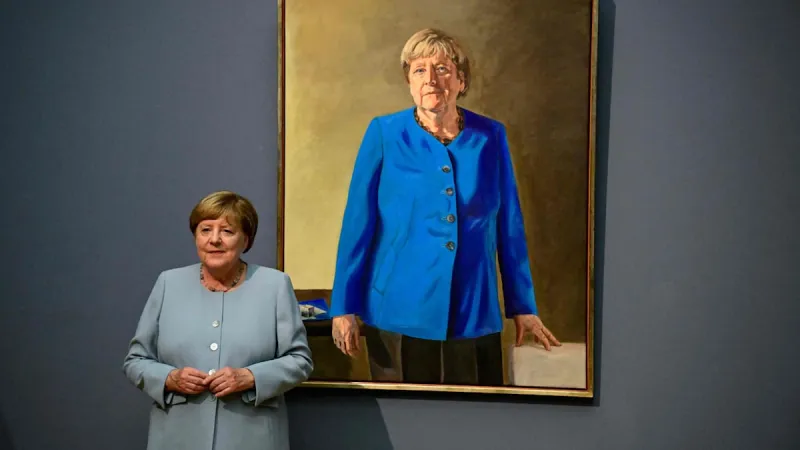
BERLIN – A new official portrait of former German Chancellor Angela Merkel, destined for the Chancellery's esteemed gallery, was publicly unveiled recently at the Bode-Museum, drawing immediate attention for its unconventional portrayal and the absence of her famous hand gesture. Painted by the lesser-known German-French artist Queyras, the artwork offers a distinct perspective on the long-serving leader, prompting commentary from art critics and political observers alike.
The unveiling marks a significant moment in Germany's political art tradition, as each former head of government receives a place in the Chancellery's ancestral gallery, formally known as the Ahnengalerie. These portraits serve as historical markers, reflecting both the subject's legacy and the artistic trends of their time.
Queyras, an artist who has largely operated outside the mainstream, brings a fresh and perhaps deliberately challenging aesthetic to the series of powerful figures. His selection for such a prominent commission suggests a desire for a contemporary interpretation rather than a purely conventional depiction of Merkel's 16-year tenure.
The most striking element, and one that immediately sparked discussion, is the omission of Merkel's distinctive hand gesture, often dubbed the Merkel-Raute or Merkel-rhombus. This pose, formed by pressing the thumbs and index fingers together to create a diamond shape, became synonymous with her public image, a symbol of stability and deliberation.
WELT columnist Hans-Ulrich Jörges articulated this sentiment, stating, “I particularly like it because we do not have the rhombus on it.” This remark encapsulates the view of many who appreciate the portrait's deviation from expected iconography, preferring a more nuanced or perhaps less predictable representation.
The decision to forgo such a recognized symbol could be interpreted in multiple ways. It might signify an attempt to look beyond the superficial political persona, focusing instead on the underlying essence of the leader. Alternatively, it could be a subtle artistic statement, challenging viewers to see Merkel anew, stripped of her most recognizable visual trademark.
Art critics suggest that Queyras's style is characterized by a certain introspection and a departure from literal representation. His previous works often explore themes of identity and presence, making him an intriguing choice for a figure as globally recognized yet often inscrutable as Merkel.
The Chancellery gallery itself is a collection of Germany's post-war leaders, including Konrad Adenauer, Willy Brandt, Helmut Schmidt, and Helmut Kohl. Each portrait offers a unique window into the personality and era of its subject, and Merkel's addition is expected to continue this tradition while adding a modern twist.
Public reception to the portrait remains varied, as is typical for artistic renditions of political figures. Some laud the boldness and originality, appreciating an artwork that dares to be different. Others might have expected a more conventional portrayal, one that embraces the familiar image of the former Chancellor.
Ultimately, the Queyras portrait of Angela Merkel invites contemplation, serving not merely as a record of her time in office but as an artistic discourse on perception, legacy, and the evolving nature of political representation in contemporary Germany. Its placement in the Chancellery will ensure it remains a topic of conversation for years to come.