 Angel Doris
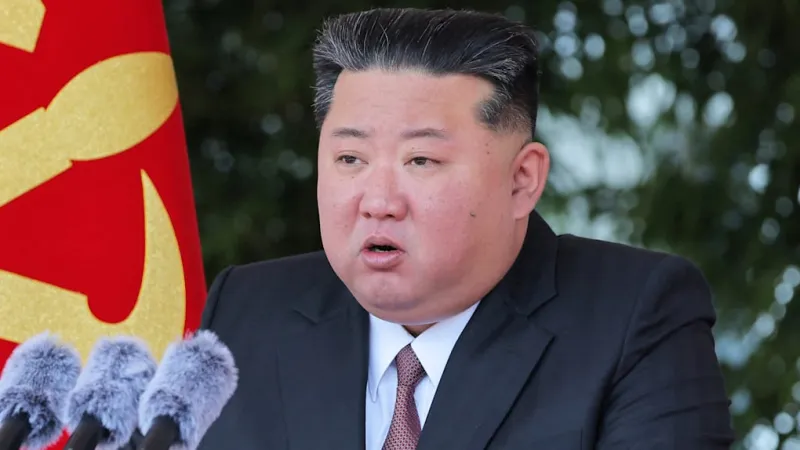
Pyongyang, North Korea has declared a substantial increase in its uranium production capabilities, confirming a doubling of output as leader Kim Jong Un vowed an exponential expansion of the nation's controversial nuclear weapons program. This assertive announcement, delivered amidst a period of heightened international tensions, signals Pyongyang's unwavering commitment to bolstering its strategic armaments despite global condemnation and sanctions.
The official state media reported the significant progress, highlighting North Korea's self-reliance in developing its atomic arsenal. Kim Jong Un reportedly outlined an ambitious strategy for further military buildup, underscoring the necessity of a robust deterrent in the face of perceived external threats.
This latest declaration arrives as international observers monitor a delicate geopolitical landscape, particularly concerning nuclear non-proliferation. The regime in Pyongyang has consistently prioritized its weapons development, viewing it as essential for national security and sovereignty.
Analysts suggest the increased uranium production points to an acceleration in the country's efforts to enhance its stockpile of fissile material. Such an expansion would enable North Korea to produce more nuclear warheads, potentially diversifying its arsenal or improving the yield of existing weapons.
The announcement inevitably draws a sharp reaction from the United States and its allies. President Donald Trump has historically maintained a firm stance on denuclearization, engaging in both direct diplomacy and rigorous sanctions against Pyongyang. This development poses a renewed challenge to his administration's foreign policy objectives in the Korean Peninsula.
The implications extend beyond material production. An "exponential expansion" suggests not only more warheads but potentially advancements in delivery systems, including intercontinental ballistic missiles. Such progress complicates regional defense strategies for South Korea and Japan, intensifying an already fraught security environment.
International bodies, including the United Nations Security Council, are expected to scrutinize this development closely. North Korea's nuclear program is in direct violation of multiple UN resolutions, which universally demand the complete, verifiable, and irreversible denuclearization of the Korean Peninsula.
The global community has for decades sought to curb Pyongyang's nuclear ambitions through a combination of sanctions and diplomatic overtures. However, these efforts have largely failed to deter the isolated nation from its trajectory of weapons development.
This recent disclosure also resonates with broader global discussions on nuclear proliferation, particularly in light of ongoing dialogues regarding other nations. For instance, President Trump remains optimistic on an Iran deal, even as regional tensions flare, underscoring the interconnectedness of these high-stakes diplomatic challenges.
The regime often frames its nuclear program as a necessary defensive measure against what it portrays as hostile policies from Washington and Seoul. State propaganda frequently reinforces the narrative of a nation under siege, justifying its military advancements.
Experts note that while the precise figures of North Korea's uranium production remain opaque to external verification, the announcement itself serves as a powerful political statement. It signals a defiant posture and a clear intention to continue, if not escalate, its nuclear trajectory.
The international community now faces renewed pressure to formulate a cohesive and effective response. The balancing act between imposing stricter sanctions and leaving avenues open for future negotiations becomes increasingly precarious with each advancement Pyongyang declares.
Seoul and Tokyo are likely to reiterate their calls for stronger international cooperation and enhanced defensive capabilities. The security alliance with the United States is a cornerstone of their respective defense postures in response to North Korea's ongoing threats.
As the world watches, the declared doubling of uranium production and the promise of exponential growth underscore the enduring challenge of denuclearizing North Korea, keeping the Korean Peninsula a flashpoint of global security concerns into 2026.