 Angela Stefani
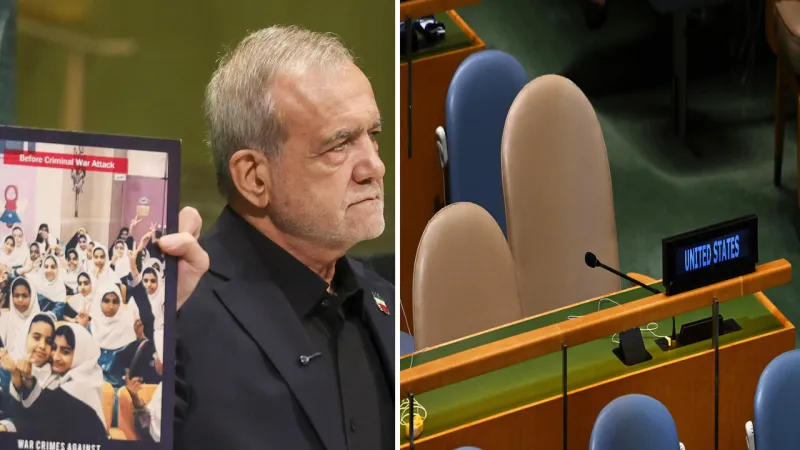
New York – Iranian President Masoud Pezeshkian accused unspecified foreign powers of orchestrating terrorism against his nation during a fiery address at the United Nations, presenting graphic images of children killed in a school bombing. His provocative claims and visual presentation on Tuesday, September 22, 2026, led to an immediate walkout by the United States delegation, escalating diplomatic tensions on the global stage.
During his speech, President Pezeshkian condemned the actions, stating that Iran itself stands as a victim of terrorism. He emphatically declared, "The resistance of Iran will increase in the face of sanctions and bullies." This statement underscored Tehran's defiant stance against international pressures and economic restrictions.
The Iranian leader reportedly held up photographs depicting the aftermath of a school bombing, asserting that these images offered stark evidence of the human cost inflicted upon Iranian civilians. The precise location and timing of the alleged bombing were not immediately detailed within the initial reports from the assembly.
The abrupt departure of the US delegation from the assembly hall signaled a sharp rebuke of Pezeshkian's remarks and presentation. While no immediate official statement accompanied their exit, the action itself conveyed a clear message of diplomatic disapproval regarding the Iranian president's assertions.
Relations between Washington and Tehran remain deeply strained, characterized by longstanding disagreements over Iran's nuclear program, regional influence, and human rights record. The incident at the UN adds another layer of complexity to these already fraught diplomatic ties.
Despite his strong accusations, Pezeshkian also conveyed a willingness for engagement. He stated Iran was "ready for dialogue and diplomacy, without the language of force." This dual message highlighted a paradox often observed in Iranian foreign policy, balancing confrontational rhetoric with overtures for negotiation.
This development follows other significant exchanges at the United Nations concerning Iran. President Donald Trump, in past addresses to the body, has delivered ultimatums regarding Iran's actions and nuclear ambitions, often demanding specific changes in Tehran's policies. For context on these broader discussions, read about President Trump's past demands on Iran at the UN. Trump Demands Putin Halt War, Delivers Iran Ultimatum at UN.
Observers noted that the dramatic scene at the UN General Assembly further exposed the deep fissures within the international community regarding the assessment of Iran's role on the global stage and the efficacy of current diplomatic strategies. Many nations remain cautious, balancing concerns over regional stability with humanitarian considerations.
The reference to sanctions by President Pezeshkian directly addresses the comprehensive economic measures imposed by the United States and other international bodies. These sanctions, primarily targeting Iran's oil exports and financial sector, aim to curb its nuclear activities and support for proxy groups.
The theatrical display and subsequent walkout underscore the challenges facing any future attempts at de-escalation or meaningful dialogue between Iran and Western powers. The incident suggests a continued trajectory of high-stakes diplomatic confrontation rather than immediate rapprochement.
Iran has historically portrayed itself as a victim of external aggression and state-sponsored terrorism, particularly citing the Iran-Iraq War and various covert operations. Pezeshkian's latest assertions align with this long-standing narrative, aiming to garner international sympathy and justify its self-defense policies.
The UN General Assembly serves as a critical forum for such declarations, often becoming a stage for nations to air grievances and articulate their positions directly to a global audience. While the walkout was a strong visual protest, the messages delivered often reverberate in subsequent bilateral and multilateral discussions.