 Robert Andrison
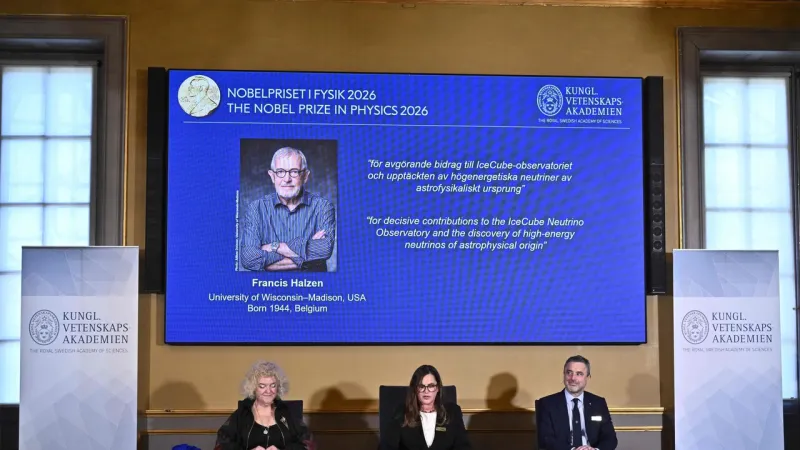
MADISON, Wis. — Francis Halzen, a distinguished physicist at the University of Wisconsin-Madison, has been awarded the Nobel Prize in Physics for his groundbreaking contributions to the discovery and understanding of cosmic neutrinos through the IceCube experiment. This monumental recognition, announced in 2026, honors his leadership in revealing the universe's most enigmatic particles, offering unprecedented insights into extreme astrophysical phenomena.
This award solidifies decades of relentless scientific inquiry. Halzen's work has not only expanded humanity's grasp of the cosmos but also heralded a new era of neutrino astronomy, utilizing these elusive particles as cosmic messengers.
Born in Belgium in 1944, Halzen emigrated to the United States, dedicating his illustrious career to particle astrophysics. His tenure at the University of Wisconsin-Madison has been marked by visionary leadership and an unwavering commitment to unraveling the universe's deepest secrets.
The IceCube Neutrino Observatory, nestled deep within the Antarctic ice, stands as the culmination of Halzen's pioneering efforts. This colossal detector, spanning a cubic kilometer, acts as a telescope, capturing the faint signals of high-energy neutrinos originating from distant galaxies and extreme cosmic events.
Cosmic neutrinos are fundamental particles that travel virtually unimpeded across vast interstellar distances, carrying information from their cataclysmic birthplaces. Unlike light, which can be absorbed or scattered, neutrinos provide an unblemished view into the universe's most violent processes, such as supernovae and gamma-ray bursts.
The definitive detection of these high-energy cosmic neutrinos by IceCube confirmed long-held theoretical predictions and opened an entirely new window onto the high-energy universe. This discovery revolutionized astrophysics, allowing scientists to pinpoint the sources of cosmic rays and study particle acceleration mechanisms in unprecedented detail.
The scientific community widely applauds this recognition of Halzen's profound impact. Experts suggest that his pioneering work sets the stage for future observatories and collaborative endeavors aimed at further deciphering the cosmic neutrino puzzle.
To better grasp the significance, imagine trying to understand a distant thunderstorm by only seeing flashes of light. Neutrinos are like hearing the thunder itself, offering a direct, unfiltered account of the storm's intensity and origin, even if obscured by clouds. This comparison illustrates the unique advantage neutrinos offer in cosmic observation.
The ongoing research at IceCube, under Halzen's continued guidance, promises further breakthroughs. Scientists hope to utilize cosmic neutrinos to map out the most energetic regions of the universe. Such discoveries echo the excitement generated by other significant astronomical findings, like the recent Phoenix Planet Discovered, Raises Solar System Fate Questions, further expanding our understanding of celestial bodies and cosmic mechanics.
Halzen's legacy extends beyond the Nobel Prize. He inspired generations of scientists, fostered international collaboration, and demonstrated the power of perseverance in the pursuit of knowledge. His dedication to pushing the boundaries of human understanding continues to resonate throughout the scientific world.
This Nobel recognition not only celebrates an individual's extraordinary achievement but also underscores the vital role of large-scale international scientific projects, like IceCube, in advancing humanity's collective knowledge of the universe. It highlights the profound impact that sustained research efforts have on our perception of reality.