 Robert Andrison
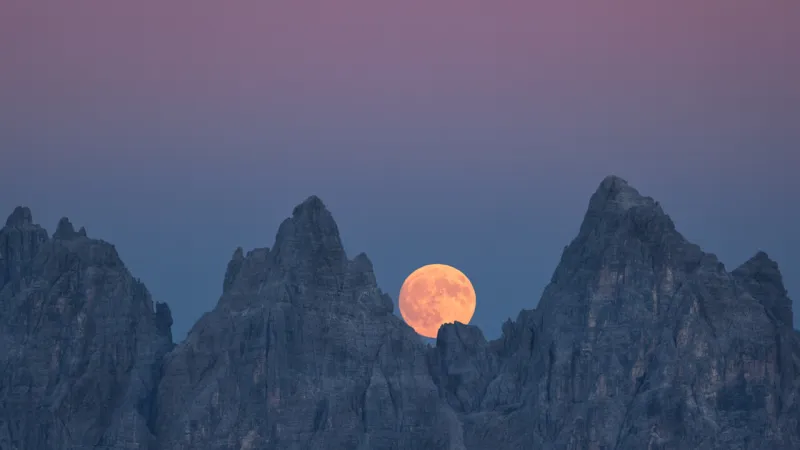
Dolomites, Italy – Astrophotographer Alessandra Masi recently captured a striking image of the moon poised majestically above the iconic Dolomite mountain range. This singular photograph, unveiled to widespread acclaim, masterfully intertwines complex atmospheric physics, celestial mechanics, and breathtaking natural grandeur, offering observers both an aesthetic marvel and a profound scientific lesson.
The image, which quickly gained traction across scientific and artistic communities, is more than merely a beautiful landscape. It serves as a visual textbook, illustrating several optical and astronomical phenomena that often go unnoticed by the casual observer. Masi’s precision in timing and composition allowed these intricate details to come to light.
One of the most prominent aspects of the photograph is the interplay of the moon's apparent size and position relative to the mountainous backdrop. This illusion is a classic example of atmospheric perspective, where Earths atmosphere distorts and filters light, subtly altering how celestial bodies appear from the ground.
Masi explained that capturing such a moment demands meticulous planning, often involving calculations of lunar phases, rise and set times, and precise camera angles. She dedicated considerable effort to understanding the unique atmospheric conditions prevalent in the mountainous region, crucial for predicting how light would interact with the lunar disk.
The Dolomites, a UNESCO World Heritage site, provide a uniquely dramatic stage for such celestial observations. Their jagged, towering peaks, formed over millions of years, offer a stark contrast to the smooth, ethereal glow of the moon, amplifying the visual impact of the captured scene.
Beyond the immediate visual appeal, the photograph invites deeper contemplation into the physics of light and observation. Phenomena such as atmospheric refraction, which causes the moon to appear flattened or distorted near the horizon, are subtly evident within Masi's work, providing tangible examples for students and enthusiasts.
This blend of art and science highlights the growing field of astrophotography, where technological prowess meets artistic vision. Practitioners like Masi bridge the gap between abstract scientific principles and accessible, inspiring imagery, encouraging a wider audience to engage with astronomy.
The photograph serves as a powerful reminder of Earths dynamic environment and its relationship with cosmic events. It underscores how seemingly distant celestial occurrences are continuously influenced and shaped by our planet's atmosphere, creating unique visual experiences.
Masi's work also evokes the historical human fascination with the moon, a constant companion in the night sky that has inspired countless myths, scientific inquiries, and artistic expressions across civilizations. Her photograph joins this rich legacy, adding a contemporary perspective, much like the anticipation for future celestial events such as those highlighted in August Delivers Celestial Spectacle: Total Solar Eclipse, Lunar Eclipse, Perseids.
The public response to the image has been overwhelmingly positive, with many marveling at the dual educational and aesthetic value. This widespread appreciation indicates a strong public appetite for content that skillfully merges scientific accuracy with visual storytelling.
Experts in optics and astronomy have lauded Masi's capture for its clarity and didactic potential. They point to specific elements within the frame that can be used to explain complex concepts like atmospheric extinction and dispersion without resorting to dense theoretical explanations.
The success of this image encourages further exploration into how photography can serve as a potent tool for science communication. By presenting intricate concepts in an easily digestible and visually stunning format, it demystifies science for the general public.
Masi herself expressed a desire for her work to inspire others, particularly younger generations, to look up at the night sky and ponder the wonders of the universe. She believes that images can ignite curiosity in ways that pure text often cannot.
The technical challenges involved, from battling light pollution to navigating extreme weather in high altitudes, attest to Masi's dedication. Such photographs are not merely opportunistic clicks but the culmination of extensive preparation and profound patience.
In an era often dominated by digital distractions, Masi's photograph offers a moment of profound connection to the natural world and the cosmos beyond. It re-centers attention on the timeless beauty that surrounds us, often hidden in plain sight.
The image will likely feature in educational materials, given its capacity to simplify complex astrophysical concepts through compelling visual evidence. Its resonance extends far beyond the realm of artistic appreciation, cementing its place as an important scientific artifact.
This event reinforces the importance of dedicated astrophotographers who, through their lens, reveal the often-unseen intricate dance between celestial bodies and our home planet. Their work continually expands our collective understanding and appreciation of the cosmos.
Ultimately, Alessandra Masi's Dolomite moon photograph is a testament to the enduring power of observation and the universal appeal of beauty when illuminated by scientific understanding. It stands as a beacon for what is achievable when art and science converge harmoniously.