 Robert Andrison
St. Petersburg, Russia – Ukrainian drone strikes ignited a substantial blaze at an online retailer's warehouse in the St. Petersburg region, injuring three people, according to Russian authorities. The coordinated attack marks a continuation of Kyivs strategy to target Russian logistical and industrial infrastructure deep within its territory, far from the front lines.
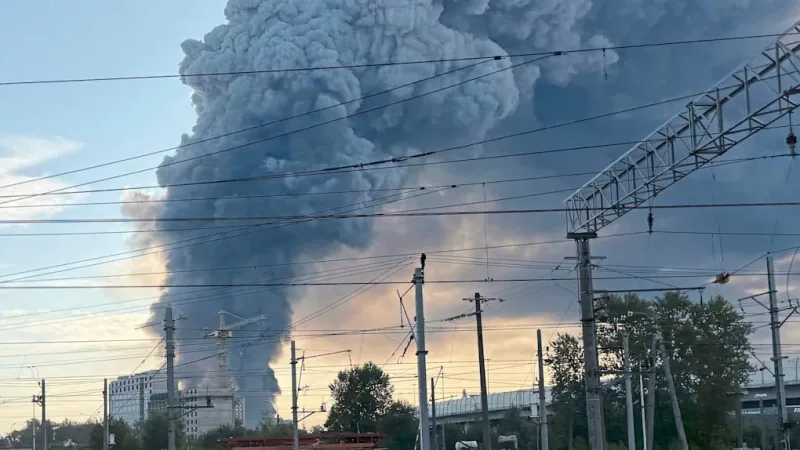
The incident, which unfolded recently, saw massive fires engulfing the storage facility. Emergency services responded to the site, battling the intense inferno for several hours. Videos circulating on social media showed towering plumes of smoke visible from kilometers away, underscoring the scale of the destruction.
Authorities in the St. Petersburg region confirmed that three individuals sustained injuries during the drone assault. Details regarding the severity of their conditions were not immediately disclosed, though officials indicated they received prompt medical attention. The precise financial cost of the damage to the warehouse and its contents is under assessment.
This assault represents a significant expansion of Ukraine's drone operations, demonstrating an increased capability to strike strategic targets within Russia's interior. Such attacks aim to disrupt supply chains, undermine logistics, and exert economic pressure on Moscow, while also challenging Russian air defense systems.
The targeted warehouse reportedly belonged to a prominent online retailer, highlighting the civilian-economic impact of these military actions. Disruptions to e-commerce and consumer goods distribution could have broader implications for the local economy and public morale in a major urban center like St. Petersburg.
St. Petersburg, Russia's second-largest city and a critical port, serves as a vital hub for transportation, trade, and industrial activities. Attacks reaching this far north into Russian territory are intended to create a sense of vulnerability and pressure within the Russian population and leadership.
Ukrainian officials have generally refrained from directly claiming responsibility for specific attacks on Russian soil but have consistently asserted their right to retaliate against Russian aggression. The ongoing drone campaign is widely perceived as a direct response to Moscows sustained aerial bombardment of Ukrainian cities and infrastructure.
The Russian Ministry of Defense typically reports on intercepted drones over its territory, often downplaying the extent of damage or casualties. However, the visual evidence and local official statements regarding the St. Petersburg incident suggest a successful strike with tangible consequences.
Analysts indicate that the evolving sophistication and reach of Ukrainian drone technology are forcing Russia to allocate more air defense resources to protect its interior, potentially drawing them away from the immediate conflict zones. This strategic diversion creates new challenges for Russian military planners.
The incident underscores the escalating nature of the conflict, with both sides increasingly employing long-range capabilities to strike at each other's vulnerabilities. As hostilities persist, the geographical scope of engagements continues to expand, transforming the strategic landscape.
Such attacks also feed into the broader narrative of the conflict, with Kyiv aiming to demonstrate its resilience and capacity to inflict costs on the aggressor. The targeting of a commercial enterprise, even if for logistical reasons, adds a layer of economic warfare to the military dimension.
As investigations into the St. Petersburg attack proceed, the international community remains largely focused on the broader implications of the ongoing conflict, with calls for de-escalation frequently voiced amidst continued hostilities.