 Demian Sahputra
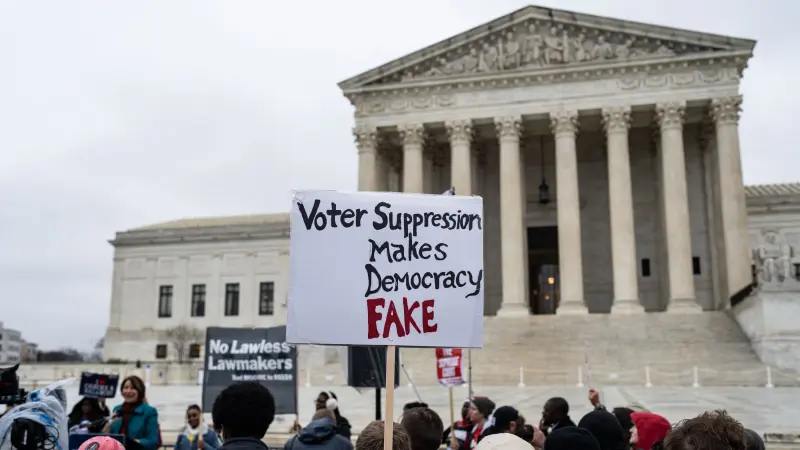
WASHINGTON — Millions of American voters find their ballots carry less weight in US House races, a growing phenomenon attributed to aggressive partisan redistricting and a series of Supreme Court rulings. This convergence of factors has solidified electoral maps, effectively cutting voters out of competitive congressional contests across the nation, especially as the 2026 midterm elections approach.
The process, often termed gerrymandering, involves state legislatures drawing congressional district lines to favor one political party, creating an abundance of so-called safe seats where the outcome is largely predetermined. This strategic manipulation of electoral geography diminishes genuine electoral competition and voter choice long before a single ballot is cast.
Driving this trend are key Supreme Court decisions that have increasingly limited federal judicial oversight of partisan gerrymandering. A landmark 2019 ruling, for example, determined that federal courts lack the authority to hear challenges to partisan gerrymanders, effectively leaving the issue to state courts and state legislatures, where partisan interests often prevail.
This judicial hands-off approach has emboldened states where one party controls both the legislative and executive branches to draw maps designed to maximize their congressional representation. The result is a political landscape where fewer districts offer a true contest of ideas and candidates, often leading to lower voter engagement and a sense of powerlessness among the electorate.
Dr. Eleanor Vance, a political science professor at Georgetown University, described the situation as deeply concerning. "When electoral outcomes are engineered through map-making rather than through robust competition, it erodes the very foundation of representative democracy," Vance stated. "Voters perceive their influence diminishing, which breeds cynicism and disengagement."
Historically, redistricting has always been a political exercise, but advancements in data analytics and mapping technology have allowed mapmakers to achieve unprecedented precision. They can now dissect demographic data, voting patterns, and even individual household preferences to create districts that are nearly impervious to shifts in public sentiment.
The impact extends beyond individual voters; it profoundly reshapes congressional dynamics. With more members beholden to primary voters in ideologically homogenous districts, the incentive to compromise or seek bipartisan solutions lessens, contributing to the legislative gridlock often observed in Washington.
During President Donald Trumps current term, the national political environment has seen an intensification of partisan battles, further amplifying the significance of electoral fairness. The stability of congressional majorities becomes less about policy popularity and more about the architects of the district lines.
Advocacy groups pushing for electoral reform argue that the current system undermines the principle of one person, one vote. "The spirit of our democratic elections is predicated on citizens having a meaningful say," remarked Benjamin Carter, executive director of Fair Maps America. "When lines are drawn to predetermine winners, millions of voices are effectively silenced, not through malice, but through a flawed system."
Looking ahead, without significant state-level reform or a re-evaluation by the Supreme Court, the trend of non-competitive US House races is likely to continue. This structural problem poses an enduring challenge to the vitality of American democracy, demanding a national conversation about fair representation and the integrity of the electoral process.
The increasing prevalence of districts designed for partisan advantage means that for many Americans, the critical decision about who represents them in Congress is made in state legislative chambers rather than at the ballot box. This ongoing shift profoundly impacts the future of American governance and political participation.