 Demian Sahputra
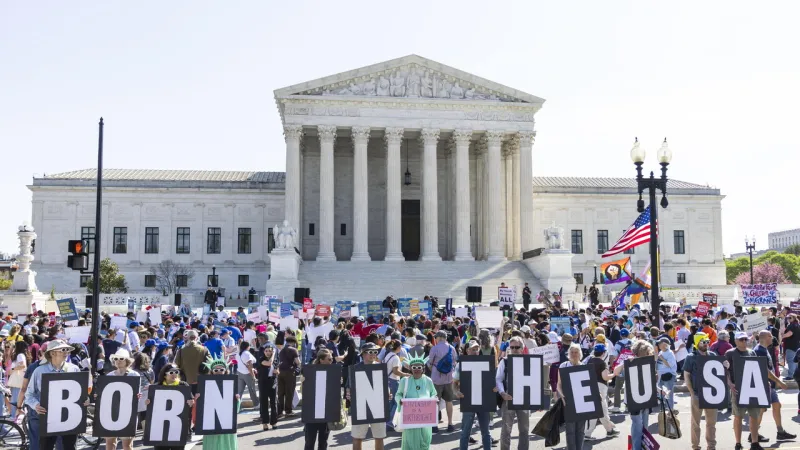
WASHINGTON, D.C. The United States Supreme Court today delivered a landmark ruling, unequivocally upholding the principle of birthright citizenship, known as ius soli. This decision marks a substantial legal defeat for President Donald Trump, who had persistently sought to dismantle this cornerstone of American constitutional law.
The ruling effectively maintains the citizenship status of individuals born on US soil, regardless of their parents' immigration status, a right enshrined in the Fourteenth Amendment. President Trump has repeatedly advocated for the abolition of this right, arguing that it incentivizes illegal immigration and should be reinterpreted or revoked through executive action or legislation.
Legal scholars and civil rights advocates hailed the Supreme Court's decision as a victory for constitutional precedent and a bulwark against attempts to redefine American citizenship. The Court's majority opinion, details of which emerged this morning, underscored the clear text and historical interpretation of the Fourteenth Amendment.
President Trump had initiated multiple legal and political maneuvers throughout his presidency aimed at challenging birthright citizenship. His administration contended that the clause “subject to the jurisdiction thereof” in the Fourteenth Amendment was not intended to cover children of undocumented immigrants or non-citizens.
However, a broad consensus among constitutional historians and legal experts has long held that the amendment's language was primarily designed to grant citizenship to formerly enslaved people and explicitly extended to nearly all individuals born within US borders, thereby overturning the Dred Scott decision.
The Supreme Court's decision provides clarity on a contentious issue that has fueled heated political debates for years. It establishes that the constitutional guarantee of birthright citizenship remains intact, effectively shutting down President Trump's direct path to alter the foundational aspect of immigration law without a constitutional amendment.
Critics of President Trump's proposals consistently warned that unilateral executive action to end birthright citizenship would be unconstitutional and would undoubtedly face immediate legal challenges. They argued that such a move would create a class of stateless individuals and undermine fundamental principles of American democracy.
While the specific vote count of the justices was not immediately disclosed, the Court's ruling signals a strong affirmation of judicial independence and the enduring power of constitutional checks and balances, even in the face of executive pressure.
The implications of this decision resonate deeply across the nation, particularly within immigrant communities. For many, birthright citizenship represents a promise of integration and opportunity, offering stability to families and ensuring that children born in the US are recognized as full citizens.
This ruling could now redirect the political discourse on immigration, shifting focus away from attempts to alter birthright citizenship and towards other legislative or administrative reforms. President Trump's administration may now explore alternative strategies to control immigration, albeit within the confines of established constitutional law.
Constitutional scholars suggest that the Court's steadfast adherence to precedent in this instance reinforces the stability of foundational legal principles. It sends a powerful message about the limits of presidential power in reinterpreting the Constitution without proper amendment processes.
Future legislative efforts to address immigration reform will now operate under the clear understanding that birthright citizenship is constitutionally protected, necessitating different approaches for policy changes.
Today's Supreme Court ruling ensures that the United States maintains its unique position among many developed nations in adhering to a broad application of ius soli, a principle that has defined American identity for over a century and a half.