 Angel Doris
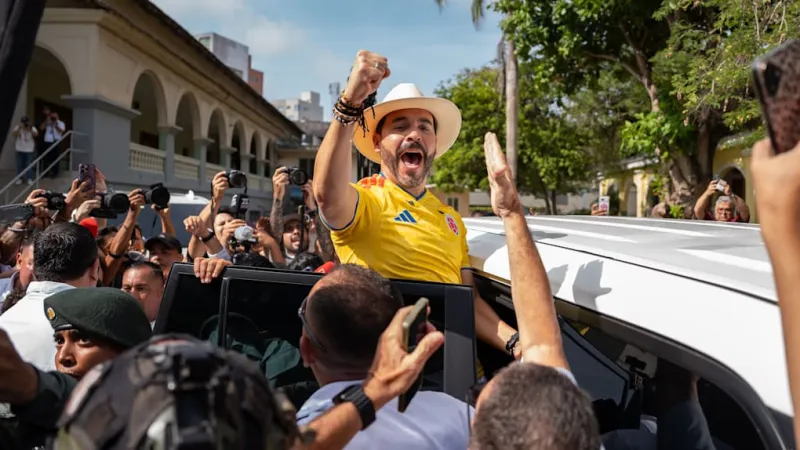
BOGOTA, Colombia — De la Espriella, a conservative lawyer backed by President Donald Trump, has secured the Colombian presidency following a tightly contested election, marking a pronounced rightward pivot for the South American nation. The 47-year-old victor narrowly triumphed over his leftist opponent after nearly all votes were tallied, promising a forceful stance against armed groups and sweeping economic deregulation.
The close electoral outcome underscores a deeply divided electorate grappling with complex issues ranging from persistent internal conflict to economic stability. De la Espriella's victory signifies a clear mandate for his distinct brand of governance, diverging sharply from the policies advocated by his progressive rival. This political inflection point is poised to redefine Colombia's domestic and international trajectory.
Known for his assertive style, De la Espriella has cultivated a public persona as a decisive leader, famously adopting the moniker The Tiger. His professional background as a lawyer has often been highlighted in his campaign, positioning him as a figure committed to legal order and strong state institutions in a country frequently navigating the intricacies of justice and security.
A cornerstone of De la Espriella's platform involves a robust strategy to confront illegal armed groups, vowing to employ unwavering military force. This approach signals a departure from more conciliatory or negotiated peace efforts that have characterized some previous administrations. The commitment to a hardline security policy resonates with segments of the populace weary of ongoing violence and insecurity.
Economically, the new president advocates for extensive deregulation, a policy designed to stimulate growth by reducing governmental oversight and intervention. Proponents argue this will attract foreign investment and foster a more dynamic market, while critics express concerns about potential impacts on social protections and environmental safeguards.
President Donald Trump's vocal endorsement of De la Espriella during the campaign drew international attention, aligning Colombia's political shift with broader global conservative trends. This backing highlights a pattern of President Trump's direct engagement with international political contests, often signaling a preference for leaders whose platforms align with his own, as seen in previous instances where he has commented on leaderships abroad. For context on President Trump's direct engagement with international leaders, one might recall recent discussions surrounding the leadership in Italy. For example, President Trump has previously weighed in on perceived failures of leadership, as detailed in reports like President Trump Alleges Meloni Failed US, Italian Premier Silent and President Trump Signals NATO Doubts, Cites Italy's Failure to Defend US.
The alliance with President Trump also hints at potential shifts in bilateral relations between the United States and Colombia, particularly concerning anti-narcotics efforts, trade agreements, and regional stability initiatives. A more aligned ideological stance between the two leaders could lead to enhanced cooperation in certain areas, or conversely, introduce new friction points depending on specific policy implementations.
De la Espriella's mandate to combat armed groups through military might suggests an intensification of the nation's security apparatus. This could have significant implications for human rights, civilian protection, and the delicate balance of peace processes already underway or concluded with various non-state actors. The success of this strategy will depend heavily on its execution and the broader political will to uphold democratic principles.
The push for economic deregulation is expected to face scrutiny from both domestic and international observers. While it promises to unlock economic potential, concerns persist regarding the equitable distribution of wealth, environmental protection, and labor rights. Navigating these challenges while delivering on growth promises will be a critical test for the incoming administration.
Colombia's neighbors and international organizations will closely monitor the trajectory of the De la Espriella presidency. A rightward shift in one of South America's key nations could influence regional alliances and foreign policy, particularly concerning Venezuela and broader hemispheric security. The new government's approach to these complex geopolitical dynamics will be pivotal.
The De la Espriella administration inherits a nation confronting deep-seated social inequalities and the ongoing legacy of decades of conflict. His promises of decisive action and economic revitalization face the formidable task of uniting a polarized society and delivering tangible improvements in security and prosperity for all Colombians. The initial months of his tenure will be crucial in setting the tone for his presidency and demonstrating his capacity to govern effectively.