 Robert Andrison
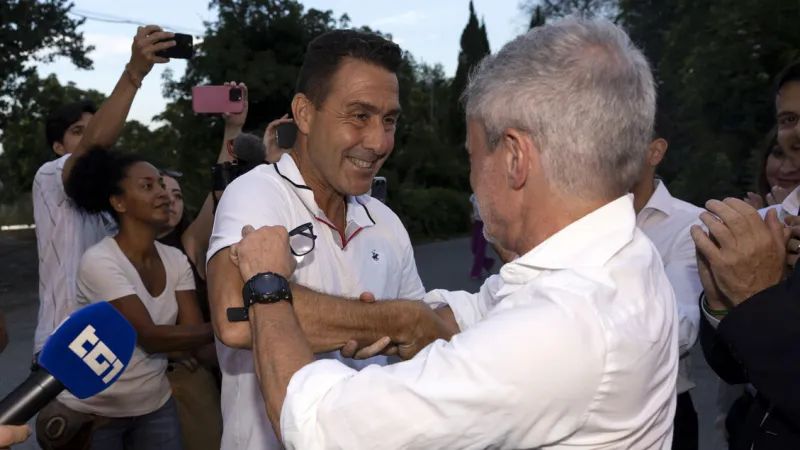
Rome - General Roberto Vannacci, a figure who has frequently ignited public debate, and former Rome Mayor Gianni Alemanno attended a private dinner in a northern Rome restaurant, where some guests reportedly raised a glass to the cry of 'a noi'. The incident, which occurred recently, has swiftly drawn attention from political commentators and the public alike, given the phrase's potent historical ties to Italian fascism and ultranationalism.
The gathering, described as an informal meeting, brought together various personalities, though specific attendees beyond Vannacci and Alemanno remain largely undisclosed. The controversial toast quickly circulated among political circles, prompting immediate scrutiny over the implications of such a phrase being used in contemporary Italian political discourse.
General Vannacci has risen to prominence in recent years, particularly following the publication of his self-penned book, which espoused views widely criticized as xenophobic and homophobic. His outspoken opinions have often put him at odds with mainstream political figures and even prompted disciplinary action from the military, from which he is currently suspended.
Gianni Alemanno, a prominent conservative politician, served as Mayor of Rome from 2008 to 2013. His political career began within the Youth Front of the Italian Social Movement, a post-fascist party. Alemanno's past associations and his presence at the dinner further amplify the perceived political symbolism of the event.
The phrase 'a noi' translates literally to 'to us' or 'for us'. Its historical significance is deeply rooted in the rhetoric of Gabriele D'Annunzio and later adopted by Benito Mussolini's fascist regime. It became a rallying cry for fascist youth movements and paramilitary groups, signifying a collective allegiance and often a call to action.
Its use today, particularly in a context involving figures like Vannacci and Alemanno, immediately evokes strong reactions, stirring concerns about a resurgence or normalization of ideologies associated with Italy's totalitarian past. Critics argue that such pronouncements are not mere historical references but deliberate provocations.
The event unfolds within a complex political landscape in Italy. The government led by Prime Minister Giorgia Meloni, whose party Brothers of Italy has historical links to post-fascist movements, has consistently sought to distance itself from accusations of neo-fascism, emphasizing its commitment to democratic values and a pro-European stance. This context makes the Vannacci Alemanno dinner particularly sensitive.
Prime Minister Meloni has previously addressed the nuances of her party's historical trajectory, asserting a clear break from fascism while acknowledging its origins. However, incidents like the reported 'a noi' toast keep the historical specter alive in public debate. As Prime Minister Meloni has noted, a leader's sway is felt deeply in politics. Meloni: Trumps Sway Felt, Politics Beyond Reality TV
Observers suggest that the timing of such an event, ahead of potential future elections, could be interpreted as an attempt to consolidate or energize a specific segment of the electorate. Vannacci himself has been a subject of speculation regarding a potential political future, possibly running for office.
The controversy surrounding the Vannacci Alemanno dinner also highlights ongoing discussions about free speech versus historical revisionism in Italy. While some defend the right to express any view, others contend that phrases with such a loaded past cross a line into apologism for totalitarian regimes.
The political ramifications of this private dinner are likely to extend beyond immediate headlines. Opposition parties are expected to leverage the incident to criticize the perceived leanings within certain conservative and right-wing factions. The event serves as a stark reminder of the vigilant watch maintained over historical symbols in Italian public life.
Italy's role on the global stage, especially its commitment to European unity and NATO, is also under constant examination. Concerns about domestic political leanings are sometimes mirrored in international scrutiny, particularly when high-profile figures are involved in controversial incidents. This also comes at a time when Italian leaders like Meloni urge for stronger European NATO roles. Meloni Urges Stronger European NATO Role Ahead of Crucial Summit
The incident underscores the enduring power of language and symbols in shaping political narratives and public perception in Italy. The simplicity of a two-word phrase, 'a noi', carries a weight of history that continues to resonate and provoke strong reactions across the political spectrum.
As investigations or public statements regarding the dinner potentially emerge, the focus will remain on how political leaders and institutions respond to what many consider a deliberate challenge to the antifascist foundations of the Italian Republic. The Vannacci Alemanno dinner has certainly provided ample material for continued political discourse.