 Chris Robert
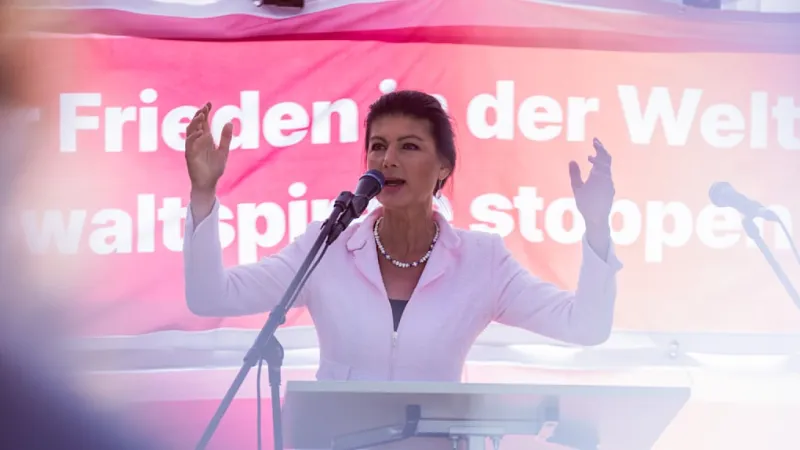
Berlin — Sahra Wagenknecht, the influential founder of the Bündnis Sahra Wagenknecht (BSW) party, has ignited a fierce political debate by advocating for a non-partisan state premier, potentially involving the Alternative for Germany (AfD), ahead of critical regional elections in Saxony-Anhalt and Mecklenburg-Western Pomerania. Her controversial remarks challenge the long-standing political consensus in Germany against cooperating with the far-right AfD, whom she characterized as utterly idiotic.
Wagenknecht explicitly condemned the established political firewall designed to exclude the AfD from government formation. This direct challenge to mainstream political parties signifies a potential shift in the German political landscape, especially as several states prepare for crucial ballots.
The upcoming state elections in Saxony-Anhalt and Mecklenburg-Western Pomerania are particularly significant. Both states have witnessed considerable electoral success for the AfD in recent years, prompting intense discussions about the future of coalition building and the viability of traditional political alliances.
Her proposal envisions a governmental structure led by an impartial Minister-President, supported by shifting majorities across the parliamentary spectrum. This model, she argues, would enable pragmatic governance, even if it requires ad hoc cooperation with parties currently shunned by the mainstream.
This stance places immense pressure on established parties like the Christian Democratic Union (CDU), Social Democratic Party (SPD), and the Greens, who have consistently ruled out any form of cooperation with the AfD. Wagenknecht's intervention could force these parties to re-evaluate their strategies or risk alienating voters frustrated with political stalemates.
The BSW, founded on a platform combining left-leaning economic policies with a more conservative stance on immigration and social issues, occupies a unique position in German politics. Wagenknecht’s willingness to discuss broader coalition possibilities, even with the AfD, distinguishes her party from many others.
The Brandmauer, or firewall, against the AfD has been a cornerstone of German democratic defense. Its purpose is to prevent the normalization of a party often accused of xenophobia and anti-democratic tendencies. Mainstream politicians have long maintained that engaging with the AfD would legitimize its divisive rhetoric.
Political analysts suggest that Wagenknecht's statement, while provocative, reflects a growing sentiment among some voters. These citizens believe that excluding a significant electoral force like the AfD from all forms of parliamentary cooperation hinders effective governance. The public discourse often grapples with balancing democratic representation and safeguarding liberal democratic values.
The declaration is expected to profoundly influence the ongoing election campaigns, forcing candidates to clearly articulate their positions on cooperating with the AfD. It could also galvanize both supporters and opponents of the AfD, leading to a highly charged political environment.
This development occurs at a time when Germany's political landscape is increasingly fragmented. Traditional grand coalitions are becoming harder to form, and new political forces like the BSW are challenging established norms. Kubicki Vows FDP Comeback, Sets Ambitious 10 Percent Target highlights another aspect of this evolving dynamic, as smaller parties contend for influence.
While not directly impacting international relations, the internal German political discourse on AfD inclusion resonates across Europe, where populist and far-right parties are gaining ground. Germany's approach to integrating or isolating such movements is watched closely by other European Union member states.
Wagenknecht's call thus represents more than a mere tactical suggestion; it is a fundamental challenge to the prevailing political doctrine in Germany, compelling a re-evaluation of how democracy functions when a significant portion of the electorate supports a controversial party.