 Angela Stefani
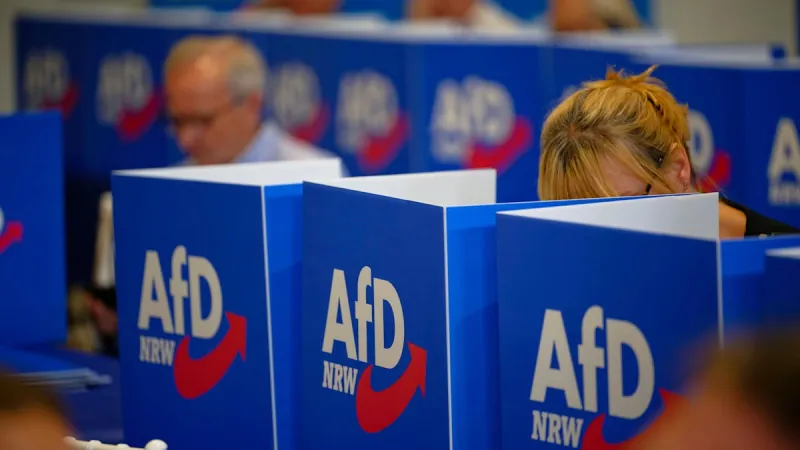
DUSSELDORF, Germany – A significant internal power struggle has intensified within the Alternative for Germany (AfD) party's North Rhine-Westphalia state association, pitting its more moderate, bourgeois faction against the voelkisch-nationalist wing. Despite this escalating conflict, political scientist Christian Stecker suggests the party may not suffer substantial setbacks in upcoming public opinion polls, attributing potential resilience to perceived missteps by established political rivals.
The deepening rift in the AfD North Rhine-Westphalia chapter spotlights the party’s persistent ideological schism. On one side stands the so-called bourgeois contingent, which aims to project a more conventional conservative image. Arrayed against them is the increasingly dominant voelkisch-nationalist camp, characterized by its ethno-nationalist rhetoric and more radical positions.
This internal discord is not a novel phenomenon for the AfD. Across its relatively short history, the party has frequently grappled with internal divisions, often concerning the ideological direction it should take. The conflict within the AfD North Rhine-Westphalia is particularly acute, given the regions political significance and the party’s desire to consolidate its electoral gains.
Christian Stecker, a prominent political scientist, offered a nuanced perspective on the situation. He posited that while the internal machinations might not directly benefit the AfD, they also would not result in massive harm to its electoral standing. This assessment challenges conventional wisdom, which often suggests that public displays of disunity deter voters.
Stecker elaborated on his reasoning, stating, "The established parties regularly supply the election campaign with mistakes." This observation implies that the perceived shortcomings or controversies of mainstream political parties often divert public attention and may inadvertently bolster the AfD, even amidst its own internal struggles. Voters, disillusioned with traditional options, might view the AfD as an alternative regardless of its internal coherence.
Indeed, the history of the AfD North Rhine-Westphalia chapter includes notable instances of internal strife. A previous report detailed how the AfD North Rhine-Westphalia Party Congress Descended Into Chaotic Power Struggle, underscoring the long-standing nature of these ideological fault lines within the party. Such events, while disruptive, have not always translated into significant declines in voter support.
The voelkisch-nationalist faction has steadily gained influence within the AfD nationally, and its strong presence in North Rhine-Westphalia reflects a broader trend within the party. This faction advocates for policies rooted in ethnic nationalism and often employs rhetoric that resonates with a segment of the electorate feeling disenfranchised by mainstream politics.
Conversely, the bourgeois wing attempts to moderate the party's image, seeking to appeal to a wider conservative base. Their struggle to assert control against the more radical elements highlights the fundamental tension at the heart of the AfD’s identity and future direction. The outcome of this struggle in NRW could set a precedent for other state chapters.
Observers suggest that voters drawn to the AfD are often motivated by specific grievances, such as concerns over immigration, economic policies, or a general distrust of the political establishment, rather than by the party’s internal harmony. Therefore, as long as these grievances persist and established parties continue to face challenges, the AfD may retain its support base.
The party’s ability to frame its internal dynamics as a vigorous debate rather than outright dysfunction also plays a role. While the media often highlights the drama, the AfD frequently presents these conflicts as evidence of its democratic processes and diverse viewpoints, a narrative that can sometimes resonate with its base.
Ultimately, the ongoing power struggle in the AfD North Rhine-Westphalia provides a critical barometer for the party's national trajectory. While it poses immediate challenges for party cohesion, the analysis from experts like Christian Stecker indicates that external factors and the perceived weaknesses of political opponents might continue to insulate the AfD from severe electoral consequences. The party's resilience in the face of internal turmoil underscores a complex political landscape where traditional rules of engagement are frequently upended.