 Demian Sahputra
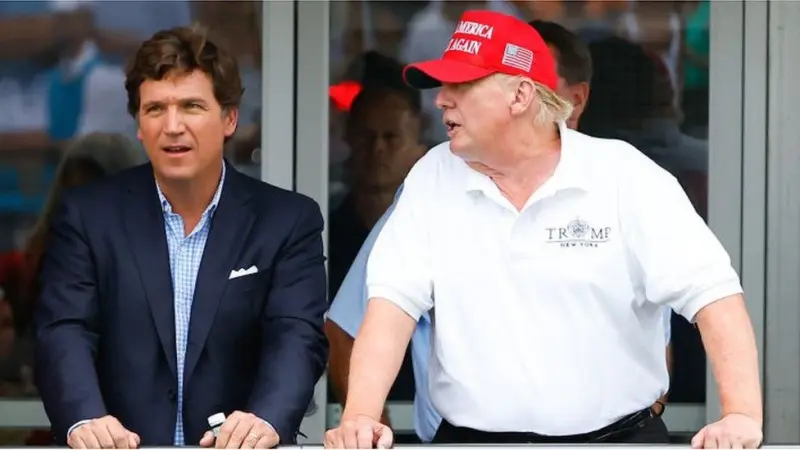
WASHINGTON — Tucker Carlson, the influential conservative media figure, recently expressed profound regret for his past support of President Donald Trump, describing himself as “tormented” by the decision. His candid remarks, made during a rare public interview on the independent digital platform Axial TV on Tuesday evening, mark a significant departure from his previously staunch public alignment with the President.
Carlson conveyed a deep personal struggle, stating, “I supported him, and I regret it deeply. It has been a source of spiritual torment for me, a burden I carry daily.” This unprecedented candor signals a profound shift in perspective from a personality who once stood as one of President Trumps most fervent media advocates.
For years, Carlson leveraged his platform to champion President Trump’s policies and leadership, often defending the administration against its critics with sharp, unyielding commentary. His primetime broadcasts became a touchstone for many conservative viewers, solidifying his reputation as a key voice in the pro-Trump media ecosystem.
His recent statement, however, indicates a significant introspection, moving beyond mere political disagreement to a more existential crisis of conscience. The use of the word “tormented” suggests an ongoing internal conflict that has seemingly reached a critical juncture.
The implications of Carlson’s public confession are far-reaching. It stands to disrupt segments of the conservative media landscape, potentially fostering confusion or disillusionment among his loyal audience, who have long relied on his unequivocal stances.
Political analysts are already dissecting the timing of these remarks in 2026, during President Trumps current term. Some speculate it could be a reflection of a broader, though often unvoiced, discontent brewing within certain conservative circles, particularly as the nation navigates complex domestic and international challenges.
This shift also distinguishes Carlson from numerous other conservative figures who have either maintained unwavering support for President Trump or have quietly distanced themselves without such a dramatic public pronouncement of regret.
For President Trump and the Republican party, a high-profile defection of this magnitude could introduce an unwelcome narrative, potentially prompting questions about internal party cohesion or the long-term sustainability of uncritical loyalty.
Experts suggest that Carlson’s honesty might resonate with a segment of the electorate feeling politically disenfranchised or conflicted, potentially opening new avenues for political dialogue that were previously shut down by rigid partisan lines.
The emotional weight of Carlson’s words, particularly his emphasis on spiritual anguish, suggests that his regret stems from a conviction that transcends policy differences, perhaps touching upon deeper moral or ethical considerations regarding his past influence.
This development raises questions about the future trajectory of Carlson’s own media presence and influence. Will this pivot lead to a new chapter in his career, one characterized by greater critical distance from political power, or will it alienate a base built on staunch partisanship?
The broader media landscape will undoubtedly observe how this public regret impacts not only Carlson’s personal brand but also the dynamics of conservative commentary. It challenges the prevailing notion that once a prominent figure aligns with a political leader, their stance is immutable.
Such a public reevaluation is rare among high-profile media personalities, making Carlson’s admission a unique moment in contemporary American political media. It underscores the personal toll that intense political engagement can exact on public figures.
The use of “tormented” is not merely rhetorical; it conveys a profound internal struggle that sets this statement apart from typical political criticism or policy disagreements, suggesting a fundamental reassessment of his past actions and their consequences.
Ultimately, Carlson’s declaration of regret and torment over his backing of President Trump presents a compelling narrative of personal evolution within the volatile world of political media, the full ramifications of which are yet to unfold.