Edward DP Situmorang
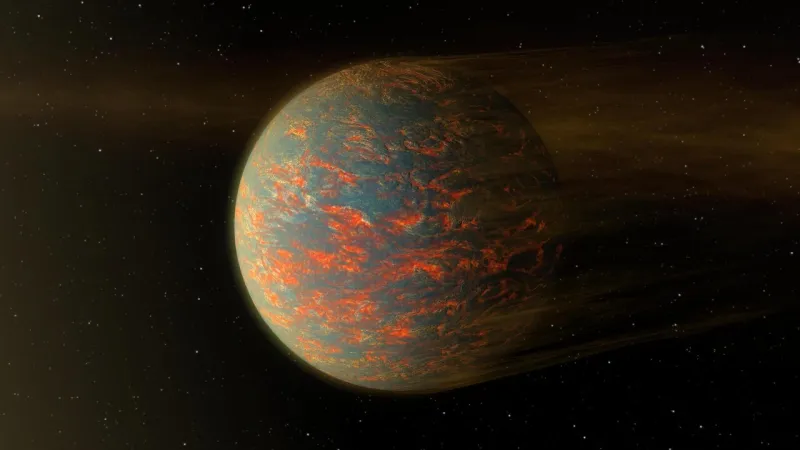
Astronomers have recently announced the groundbreaking discovery of the coldest lava world ever identified, an exoplanet orbiting a distant star that astonishingly possesses a discernible atmosphere. This celestial body, distinct from anything previously observed, offers scientists an unparalleled window into the extreme conditions that may have characterized Earth during its own primordial stages.
Designated specifically for its unique characteristics, this exoplanet represents a class of super-Earths or mini-Neptunes where intense heat typically renders surfaces molten. Yet, this newly found world defies conventional expectations by exhibiting temperatures significantly lower than other known lava planets, making its classification a point of considerable scientific interest and further investigation.
The presence of an atmosphere on such a dynamically active body is particularly intriguing. While details regarding its precise composition are still under analysis, the very existence of a gaseous envelope suggests a complex interplay of geological activity and atmospheric retention, potentially involving silicate vapor and other volcanic outgasses characteristic of a molten surface.
Scientists are drawing compelling parallels between this exoplanet and the conditions believed to exist on our own planet approximately four billion years ago. During Earths Hadean eon, our world was a hellish landscape of constant volcanism, a magma ocean surface, and a dense, noxious atmosphere, much like what this distant world may embody. This parallel makes the discovery invaluable for planetary evolution studies.
The advanced observational techniques employed for this discovery likely involved sophisticated space telescopes capable of detecting subtle variations in starlight as the exoplanet transits its host star. Further spectroscopic analysis would then have been used to probe the atmospheric composition, revealing the chemical fingerprints of gases present.
This finding challenges some prevailing theories about the formation and evolution of extremely hot planets. The fact that a lava world can maintain an atmosphere while being relatively cooler suggests a broader range of conditions under which planets can retain their gaseous layers, impacting our understanding of planetary habitability.
Its designation as the coldest lava world does not imply frigid temperatures in an absolute sense, but rather a comparatively lower surface temperature than other exoplanets confirmed to possess a molten surface. This relative coolness could be attributed to a combination of factors, including its orbital distance from its star, its size, or its specific geological composition.
The scientific community anticipates extensive follow-up observations using next-generation telescopes. These studies will aim to refine estimates of the exoplanets mass, density, and atmospheric structure, offering crucial data points for models simulating early planetary development. The hope is to unravel the mechanisms sustaining its unique atmospheric blanket.
Exoplanet discoveries have become increasingly common, yet worlds like this remain rare. While thousands of exoplanets have been cataloged, those providing direct analogs to specific early stages of Earths history are particularly prized. This specific lava world stands out as an exceptional case among the growing cosmic inventory.
Ultimately, this discovery contributes significantly to the broader quest for understanding how planets form, evolve, and potentially support life. By studying these extreme environments, researchers gain critical context for defining the boundaries of habitability and the diverse pathways planets take through their cosmic lifespans.