 Angel Doris
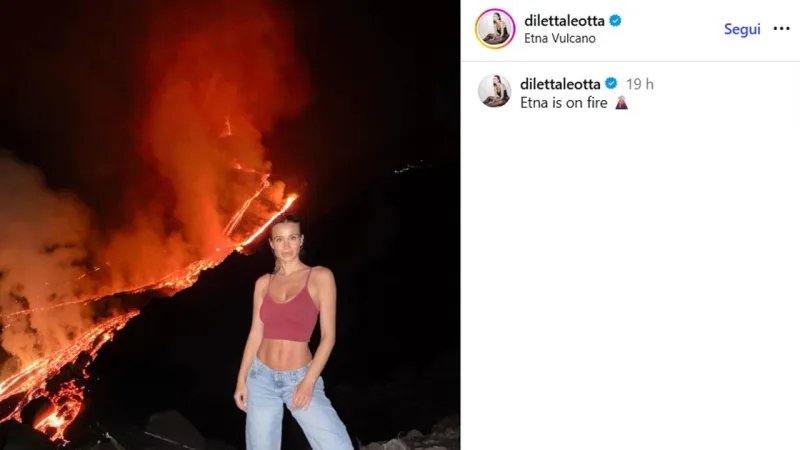
Catania, Italy – Italian sports presenter Diletta Leotta recently ignited a fervent debate across social media platforms after sharing striking images of herself near the active lava flows of Mount Etna. The widely circulated photographs, captioned “Etna is on fire,” prompted immediate criticism from segments of the public who deemed her perceived proximity to the dangerous volcanic activity irresponsible and potentially hazardous.
The controversy swiftly gained traction as viewers questioned the safety implications of Leotta posing so close to one of the worlds most active volcanoes. Mount Etna, a UNESCO World Heritage site, frequently displays effusive eruptions, characterized by steady lava flows, which, while often slow-moving, pose significant risks due to extreme heat and unpredictable changes in terrain.
Many social media users and commentators voiced concerns that the Diletta Leotta Etna photos might encourage others to emulate similar risky behavior, particularly given Leotta's considerable following. Critics argued that public figures bear a responsibility to promote safety, especially when interacting with powerful natural phenomena.
However, subsequent video footage and analyses emerged suggesting that the dramatic perspective in Leotta's still photographs might have been an optical illusion. These videos indicated a flattened effect, common in photography, which made her appear much closer to the incandescent lava streams than she actually was.
The visual evidence from various angles provided a different context, leading to a split in public opinion. While some maintained their initial criticism, others acknowledged that photographic distortion could explain the perceived peril, shifting the focus from recklessness to the nuances of visual media.
Mount Etna, situated on the east coast of Sicily, stands as a constant geological spectacle. Its persistent activity often leads to spectacular but dangerous displays. Authorities regularly issue warnings and establish exclusion zones to ensure public safety around its volatile flanks. It is critical for visitors to adhere strictly to these guidelines.
Diletta Leotta is a prominent figure in Italian media, known for her sports broadcasting roles and large presence on social media. Her posts frequently garner significant attention, making her a powerful influencer. This amplified the reach and intensity of the discussion surrounding her Etna images.
This incident underscores a recurring theme in the age of social media: the fine line between capturing compelling content and promoting unsafe practices. The pursuit of viral moments often pushes individuals, including public personalities, to engage in activities that may misrepresent risk or inadvertently encourage dangerous imitation.
The incident occurs against a backdrop of increasing climate awareness and environmental concerns in Italy. The nation has recently faced extreme heat conditions, leading to red alerts across various regions. Such events heighten public sensitivity to natural phenomena and the responsible representation thereof. For more on this, refer to Italy Endures Another Week of Extreme Heat; Red Alerts Soar.
The episode also serves as a potent reminder of the importance of media literacy, particularly in discerning the authenticity and context of images shared online. What appears to be an immediate danger can sometimes be an artifact of photographic technique, highlighting the challenges of interpreting visual information in the digital age.
Ultimately, the debate around Diletta Leotta's Etna photos, irrespective of intent or photographic distortion, has sparked a broader conversation about influencer responsibility and public safety near natural hazards. It reiterates that even seemingly innocuous social media posts can trigger significant public discourse and scrutiny.