 Edward DP Situmorang
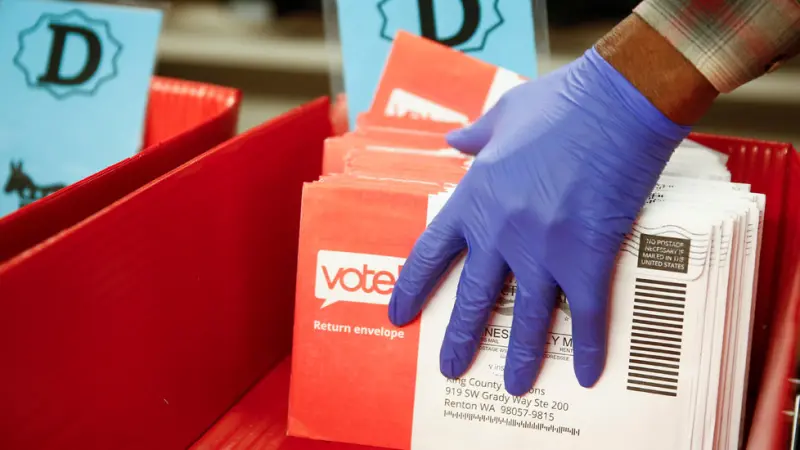
WASHINGTON — President Donald Trump today signed an executive order aiming to significantly expand federal oversight of mail voting, a move that immediately drew sharp condemnation from Democrats and voting rights advocates who view it as an unprecedented assault on states' traditional authority over elections. The action, announced from the Oval Office, arrives amidst President Trump's continued promotion of unsubstantiated claims of widespread fraud associated with mail-in ballots.
The executive order, titled Enhancing Election Integrity and Security Through Federal Coordination, directs various federal agencies, including the Department of Homeland Security and the Department of Justice, to develop new guidelines and potentially intervene in state-level mail voting procedures. Proponents within the administration assert this is a necessary step to safeguard the electoral process against what they describe as inherent vulnerabilities in current systems.
Opponents, however, argue that the President lacks the constitutional authority to unilaterally impose such federal control. Legal scholars are already predicting immediate challenges to the order in federal courts, contending that election administration is primarily a state function, codified within the Tenth Amendment of the U.S. Constitution.
President Trump reiterated his long-standing concerns about mail voting during a press briefing following the signing. He stated, "We cannot have secure elections when ballots are sent to everyone, regardless of whether they requested one. This order will ensure every legal vote counts and stop the fraud that undermines our democracy."
Voting rights organizations across the nation quickly denounced the executive order, calling it an attempt to suppress voter turnout and undermine public confidence in democratic institutions. A spokesperson for the American Civil Liberties Union commented, "This is a direct attack on the fundamental right to vote and a dangerous overreach of executive power. We will fight this order with every legal tool at our disposal."
The order's language appears to give federal agencies broad latitude to scrutinize state mail ballot verification processes, ballot drop-off locations, and even voter registration database maintenance. Critics fear this could lead to a patchwork of confusing regulations and increased barriers for eligible voters, particularly in states with well-established mail voting systems.
Many states, including Oregon, Washington, and Colorado, have conducted elections predominantly by mail for years with high rates of participation and minimal documented fraud. These states often employ robust security measures, such as signature verification and ballot tracking, which have been lauded by election integrity experts.
The President's action comes as the nation gears up for the 2026 midterm elections, where the control of both chambers of Congress is expected to be fiercely contested. The timing of the order is seen by many as a strategic maneuver to energize his base and frame election security as a central issue for the upcoming campaign cycle.
Congressional Democrats reacted sharply, with Senate Minority Leader Chuck Schumer calling the executive order "a reckless abuse of power designed to disenfranchise millions of American citizens." He pledged to work with legal groups and state officials to resist the order's implementation.
Election integrity experts widely concur that while isolated incidents of voter fraud can occur, systemic and widespread fraud in U.S. elections, particularly through mail-in voting, is exceedingly rare and unsupported by empirical evidence. Studies by various nonpartisan organizations have consistently affirmed the overall security of mail voting systems when proper safeguards are in place.
The full implications of the executive order remain uncertain, contingent upon legal challenges and the willingness of federal agencies to aggressively pursue its directives. However, it undoubtedly sets the stage for a significant legal and political battle over the future of election administration in the United States.