 Demian Sahputra
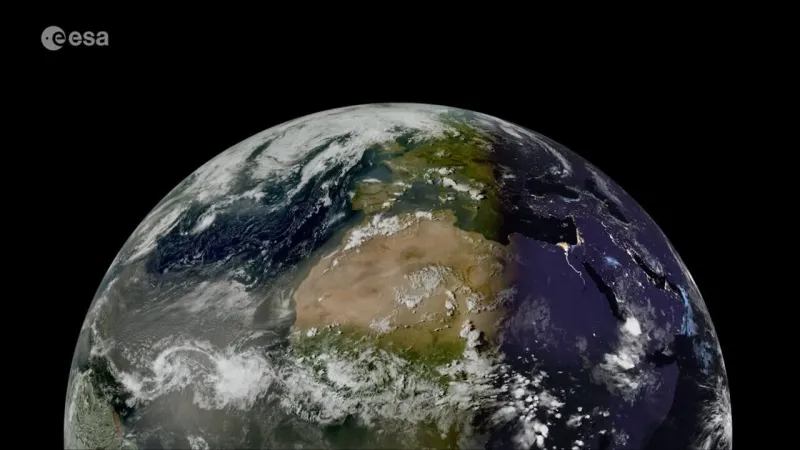
The European Space Agency (ESA) recently unveiled spectacular images depicting the Moon's immense shadow sweeping across Earth's surface during a recent solar eclipse, a cosmic spectacle captured with unprecedented clarity by the advanced Meteosat Third Generation Imager (MTG-I1) satellite. These visuals, released to an eager scientific community and the public, offer a unique, orbital perspective on one of nature's most dramatic celestial alignments.
This groundbreaking achievement was made possible through the state-of-the-art capabilities of the MTG-I1, a geostationary satellite designed primarily for enhanced weather forecasting and climate monitoring. Its ability to capture rapid, high-resolution imagery across multiple spectral bands allowed for the detailed observation of the lunar umbra and penumbra as they momentarily darkened vast swathes of the planet.
A solar eclipse occurs when the Moon passes directly between the Sun and Earth, casting a shadow that temporarily blocks the Sun's light. From the ground, observers experience a brief twilight, but from Earth's orbit, the event transforms into a grand, visible demonstration of orbital mechanics, revealing the Moon's silhouette against the vibrant blue and white of our home planet.
The images provided by ESA underscore the satellite's versatile utility beyond its meteorological mandate. Scientists anticipate that such detailed observations from space will contribute significantly to understanding atmospheric dynamics, particularly how sudden temperature changes during an eclipse might influence local weather patterns and phenomena.
Observing an eclipse from an orbital vantage point provides a dramatically different experience than from the ground. While millions worldwide gaze upwards, a satellite looks down, witnessing the colossal lunar shadow chase the rotation of the Earth, creating a mesmerizing, ephemeral patch of darkness that travels thousands of miles. This perspective highlights the true scale of these celestial events.
Public fascination with eclipses remains high. During the recent solar eclipse, cities like Venice experienced the rare phenomenon, drawing crowds to witness the partial obscuration of the sun. Such terrestrial observations, coupled with the new satellite data, create a comprehensive picture of the event from multiple dimensions. Venice Halts: Rare Solar Eclipse Captivates Lagoon City.
An ESA spokesperson stated, "These images exemplify the groundbreaking capabilities of the Meteosat Third Generation Imager. We are not only improving our weather prediction models but also providing humanity with awe-inspiring views of our solar system's intricate dance." This sentiment reinforces the dual purpose of many space missions: scientific advancement and public engagement.
The MTG-I1 represents a significant leap forward in European meteorological satellite technology. Launched as the first of a new generation of satellites, it boasts a Flexible Combined Imager that can scan the entire Earth disk in just 10 minutes, and a Lightning Imager, which continuously monitors lightning flashes across Europe and Africa. This advanced instrumentation proved invaluable in capturing the fleeting shadow of the Moon.
Historically, capturing the full scope of a solar eclipse from space with such fidelity was a challenge. Earlier satellites provided views, but the resolution and temporal frequency of MTG-I1 offer unparalleled detail, allowing researchers to track the shadow's progression with remarkable precision. This technological progress continually pushes the boundaries of what is observable from orbit.
These detailed captures of the Moon's shadow during a solar eclipse serve as a powerful reminder of humanity's ever-growing capacity to explore and comprehend the universe around us. They bridge the gap between complex scientific instruments and the breathtaking natural phenomena they are designed to observe, fostering a deeper appreciation for both.
The data gleaned from these eclipse observations also contributes to the broader understanding of Earth's interaction with celestial bodies. While the immediate impact of a solar eclipse on climate is localized and temporary, long-term data collection from satellites like MTG-I1 helps refine models that predict more subtle, ongoing environmental changes.
Furthermore, the public release of such high-quality imagery often ignites interest in science and space exploration among younger generations. These visually stunning representations of an eclipse from space transform abstract scientific concepts into tangible, captivating realities, encouraging future astronomers and engineers.
The European Space Agency, in collaboration with EUMETSAT, operates the Meteosat constellation, providing critical weather data to member states. The MTG program signifies a commitment to maintaining Europe's leadership in meteorological satellite technology for decades to come, ensuring the continuity and enhancement of vital environmental monitoring services.
The intricate ballet between the Moon, Earth, and Sun, so vividly depicted from orbit, highlights the dynamic nature of our solar system. Each solar eclipse offers a unique data point, and the ability to record it from above enhances our scientific record, adding layers of information previously unattainable.
Ultimately, these astonishing satellite images of the Moon's shadow during a solar eclipse are more than just scientific data points; they are a testament to human ingenuity and our enduring quest to observe, understand, and share the wonders of the cosmos. They allow us all to see our planet through the eyes of a satellite, revealing the grandeur of celestial mechanics.