 Robert Andrison
Erfurt, Germany – A significant political confrontation is brewing in Germany as the Alternative for Germany (AfD) party prepares to hold its annual conference in Erfurt in early July. This event is set to become a flashpoint for intense demonstrations, with organizers anticipating up to 60,000 individuals mobilizing to prevent the gathering, sparking widespread concern over potential civil unrest.
The prospect of such a large-scale intervention has amplified an ongoing national debate concerning the boundaries of legitimate protest and the right to assembly. Discussions have critically examined the potential for these planned blockades to escalate beyond peaceful dissent into confrontations that could lead to violence.
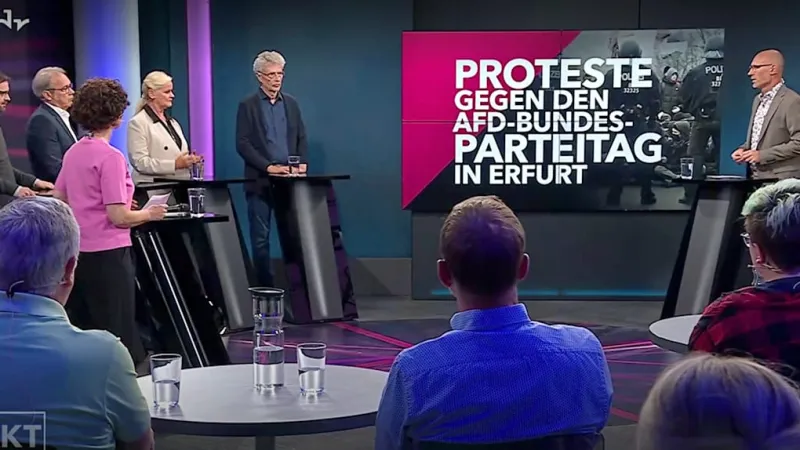
Central to these concerns was a recent MDR-Talk, where representatives from the “Widersetzen” alliance, a key organizing force behind the protests, engaged with constitutional lawyers and protest researchers. The panel rigorously dissected the implications of preventing a legally sanctioned political party from holding its conference.
During the televised discussion, a stark warning was articulated: the physical prevention of the AfD party conference could directly lead to violence. This statement underscores the precarious nature of the planned demonstrations and the high stakes involved for both protestors and authorities.
Constitutional lawyers emphasized the fundamental right to peaceful assembly and free speech, enshrined within Germany's basic law. However, they also highlighted the limitations of these rights when they infringe upon the rights of others, or when they threaten public order and safety. The right of a political party to conduct its internal affairs, including holding a conference, is generally protected.
Protest researchers contributed to the discourse by analyzing historical precedents of large-scale demonstrations and their outcomes. They cautioned that while mass mobilization can be a powerful tool for democratic expression, the intent to physically obstruct an event crosses a critical line, potentially inviting counter-reactions and clashes.
The “Widersetzen” alliance has openly stated its objective to disrupt the AfD conference, viewing its policies and rhetoric as a threat to democratic values. Their strategy reportedly includes blockading access routes and the conference venue itself, aiming to make the gathering unfeasible through sheer numbers and persistent presence.
Authorities in Erfurt and the wider Thuringia state are preparing for an extensive security operation. The deployment of a significant police presence will be necessary to manage the 60,000 anticipated demonstrators, maintain public order, and ensure the safety of all citizens, including both protestors and conference attendees.
The political climate in Germany remains highly charged, with the AfD continuing to be a controversial force. Public sentiment is sharply divided, making the upcoming Erfurt conference a particularly sensitive event that tests the limits of political tolerance and expression within a democratic society.
Questions about the proportionality of the planned actions also emerged during the MDR-Talk. While many Germans vocally oppose the AfD’s agenda, the method of outright prevention raises complex ethical and legal dilemmas about suppressing a political party's ability to convene, even one with contentious viewpoints.
This incident highlights a growing tension across European democracies where populist and far-right parties gain traction, provoking strong counter-movements. The challenge for states is to uphold democratic principles, including freedom of assembly for all political entities, while simultaneously ensuring public safety and preventing escalation into civil disorder.
The Erfurt event will serve as a critical test for German society, showcasing how it navigates the competing demands of protest rights, political freedom, and the imperative to prevent violence. The outcome will likely influence future protest strategies and the official responses to them across the nation.
Local businesses and residents in Erfurt are also bracing for the disruptions that accompany such large-scale events. Road closures, increased security, and the potential for confrontations could significantly impact daily life in the city for the duration of the party conference and associated protests.