 Angela Stefani
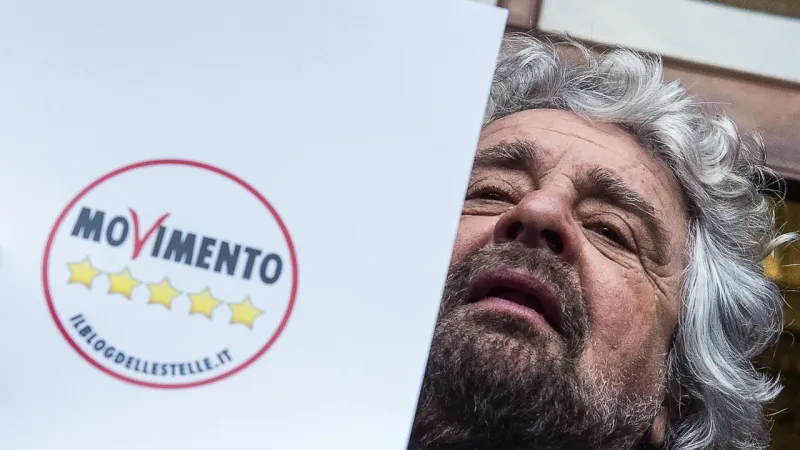
ROME – Beppe Grillo, the charismatic and often unpredictable co-founder of Italy's Five Star Movement (M5s), recently unleashed a scathing indictment of his own creation, asserting that the once-revolutionary political force "has lost its identity" and "they got conceited without reading the instructions." Writing on his personal blog, Grillo articulated his deep dissatisfaction, stating that the movement "was supposed to change politics; politics changed them."
Grillo's pointed remarks illuminate a simmering tension between the movement's original anti-establishment ethos and its evolving role within mainstream Italian governance. His critique comes at a pivotal time for Italian politics, where coalition dynamics frequently shift, as exemplified by recent reports of discord within other majority parties, such as those detailed in Tajani's Safe Program Correction Ignites Italian Majority Discord.
The Five Star Movement emerged onto the Italian political scene in 2009, spearheaded by Grillo, a popular comedian, and Gianroberto Casaleggio, a web entrepreneur. Its foundational principles centered on direct democracy, environmentalism, anti-corruption, and a fierce opposition to traditional political parties, which it often derided as the political elite.
The M5s promised a radical departure from established norms, advocating for citizens participation and a streamlined, transparent government. It aimed to disrupt the status quo and introduce a new paradigm for governance rooted in digital engagement and ethical conduct.
Initially, the movement harnessed significant public discontent with Italys political class and economic stagnation, skyrocketing in popularity. It achieved remarkable electoral success, culminating in it becoming the largest single party in the 2018 general election, ultimately forming governing coalitions. This rapid ascent from an online blog to a national political powerhouse was unprecedented.
However, Grillo now contends that this journey into the corridors of power has come at a steep price. His recent blog post suggests that the idealism and original vigor that defined the M5s have waned, replaced by a more conventional political approach that mirrors the very institutions it sought to reform. The founder implies a strategic drift, where tactical compromises have overshadowed foundational principles.
His core argument, conveyed through his blog, explicitly blames the political system for absorbing and transforming the movement, rather than the movement transforming politics. This sentiment underscores a profound concern that the Five Star Movement, once a disruptive force, has assimilated into the political establishment, losing its distinct voice and purpose in the process.
This latest broadside from Grillo is not an isolated incident. The comedian has historically maintained an influential, albeit sometimes peripheral, role in the movement, frequently intervening with provocative statements or blog posts that have often shaped public discourse around the M5s. His past pronouncements have sometimes created internal friction, but always underscored his significant sway as the ideological guidepost.
Political analysts suggest that Grillos intervention could further complicate the M5s leaderships efforts to redefine the party and solidify its electoral base. As Italy navigates complex domestic and international challenges, maintaining a coherent identity becomes paramount for any political entity. The internal critique from its founder adds another layer of complexity.
The M5s leadership now faces the challenge of responding to its founder's criticisms while attempting to project an image of unity and effectiveness. How the party reconciles Grillo's potent accusations with its current political strategy will be crucial for its future relevance in a dynamic Italian political landscape. The integrity of its founding principles, once its greatest strength, now appears to be a point of internal contention.