 Edward DP Situmorang
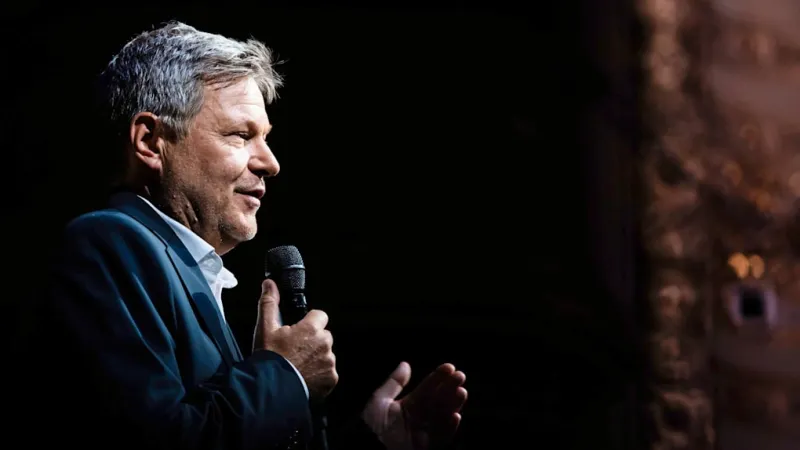
BERLIN – Robert Habeck, a prominent figure in Germany's Green Party and former Vice Chancellor, has publicly declared his skepticism regarding the Free Democratic Party (FDP) under the leadership of Wolfgang Kubicki. Habeck contends that the FDP, as currently constituted, does not represent the vital liberal force necessary for the nation's political landscape, signaling a significant ideological divergence within the German political spectrum.
Habeck explicitly stated, "That is not the liberal force this country needs." This direct criticism underscores his belief that the FDP, traditionally a key player in German coalition governments, has strayed from a path of genuine renewal and progressive liberal policy.
The former Minister for Economic Affairs and Climate Action further lamented what he perceives as a gaping void within the German party system. This refers to a lack of a robust, forward-looking liberal voice that can address contemporary challenges effectively.
The FDP, a liberal-centrist party, has faced considerable challenges in recent years, oscillating between periods of governmental participation and electoral setbacks. Its internal dynamics, particularly leadership questions, frequently draw scrutiny from political observers and rivals alike.
Wolfgang Kubicki, a veteran FDP politician known for his outspoken demeanor, assumed a pivotal leadership role within the party amidst these turbulent times. His tenure has been marked by efforts to redefine the FDP's public image and political strategy.
Habeck's own Green Party, part of the current government coalition, often finds itself in ideological opposition to the FDP on various policy matters, including economic regulations, environmental protection, and social reforms. This public rebuke highlights the ongoing tensions.
Such a stark assessment from a leading Green politician carries weight, suggesting deeper rifts that could influence future coalition formations and the overall direction of German governance. The perceived absence of a certain liberal ideology could reshape political discourse.
The FDP's internal power struggles have been well-documented. For instance, Kubicki's previous ascendancy within the party, as highlighted by articles like Kubicki Prevails in FDP Power Struggle, Party Comeback Remains Precarious, demonstrated his resilience but also underscored the precarious nature of the FDP's standing.
Despite internal victories, the FDP continually navigates a complex political environment, striving to maintain relevance in a multi-party system increasingly fragmented by the rise of new movements and shifting voter allegiances. This ongoing challenge is central to Habeck's critique.
Habeck's remarks implicitly call for a profound re-evaluation within the FDP, urging the party to embrace a form of liberalism that he believes is more aligned with the modern needs of German society. This vision likely encompasses economic liberalism tempered with social responsibility and environmental consciousness.
While the immediate response from the FDP was not detailed in the source, it is likely that party strategists would counter Habeck's assertions, emphasizing their commitment to core liberal principles and their role in Germany's economic stability and individual freedoms.
The discourse surrounding the FDP's identity unfolds against a backdrop of significant global and domestic challenges, including economic pressures and geopolitical shifts. The search for clear ideological leadership within parties becomes paramount in such times.
Should the political landscape shift again, Habeck's comments could complicate potential future coalition talks involving the FDP, especially with parties like the Greens, who might demand a more ideologically coherent and renewed liberal partner.
Historically, the FDP has played a crucial role as a kingmaker in German politics, often partnering with either the Christian Democrats (CDU/CSU) or the Social Democrats (SPD). Its current trajectory, however, suggests a re-evaluation of its traditional role.
The public admonition by Robert Habeck spotlights the persistent debate surrounding the FDP's future and its capacity to embody a truly impactful liberal force in contemporary German politics. The discussion continues to resonate as Germany seeks to navigate its complex challenges.