 Angel Doris

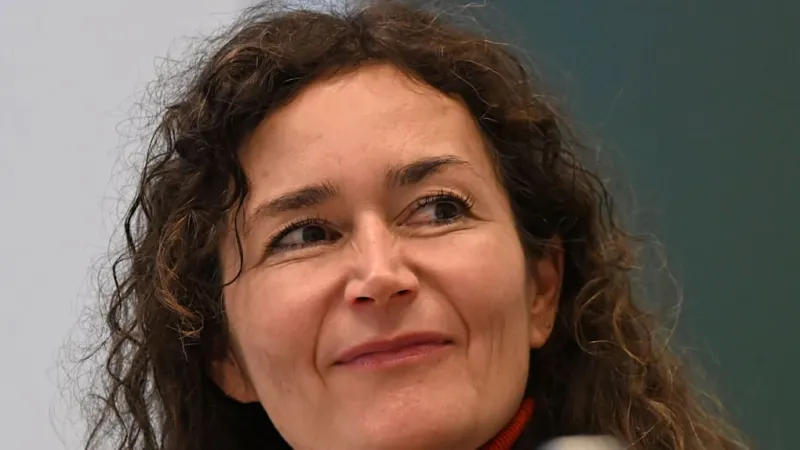
BERLIN – Ricarda Lang, co-leader of the German Green Party, recently challenged Chancellor Friedrich Merz and the prevailing political discourse on migration, arguing that a reduction in immigration would not automatically lead to a decline in support for the far-right Alternative for Germany (AfD). Speaking on the popular political talk show Hart aber fair, Lang underscored the imperative of maintaining a robust democratic firewall against the AfD, amidst a national debate focused on societal cohesion. Her remarks highlighted a perceived "profound problem" in the Chancellor's approach to the burgeoning populist movement.
Lang's direct assessment of Chancellor Merz's strategy reflects a growing divergence within German mainstream politics regarding how best to counter the AfD's ascent. The Chancellor, representing a more conservative stance, has often emphasized stricter migration policies as a means to address public anxieties and, by extension, weaken the AfD's appeal. Lang's intervention suggests this perspective is overly simplistic and potentially misdiagnoses the root causes of the AfD's electoral gains.
The Green Party leader explicitly dismissed the notion that less migration equals less AfD. She contended that such a direct correlation oversimplifies the complex socio-economic and cultural factors contributing to the far-right party's success. Instead, Lang advocated for a broader approach that addresses citizens' concerns comprehensively, rather than narrowly focusing on immigration figures.
The discussion on Hart aber fair centered on societal cohesion, a pressing issue in Germany as political polarization intensifies. The AfD's rise has been accompanied by heightened debates over national identity, integration, and the future direction of the country. Lang's remarks positioned the Greens as champions of an inclusive society, contrasting with what she sees as a potentially divisive narrative.
Crucially, Lang reiterated her unwavering defense of the Brandmauer, or firewall, against the AfD. This concept refers to the steadfast refusal of mainstream democratic parties to cooperate or form coalitions with the AfD at any level of government. Her firm stance aims to prevent the legitimization of a party widely considered to harbor extremist elements and anti-democratic tendencies.
The AfD has experienced significant gains in recent years, reaching unprecedented levels in national and regional polls, a trend that has alarmed established parties. For additional context on this phenomenon, readers can refer to our previous reporting on AfD Ascends in German Polls: Expert Urges Democratic Poise. This surge has forced other political actors, including Chancellor Merz's administration, to re-evaluate their strategies for engaging with and countering the populist challenge.
From the Green Party's vantage point, the fight against the AfD is not merely about border control but about upholding democratic values and fostering social justice. Lang's statement aligns with the Greens' long-held principles, which emphasize human rights, environmental protection, and a welcoming approach to refugees and migrants, while simultaneously advocating for robust integration policies.
Lang's diagnosis of a "profound problem" in Chancellor Merz's strategy likely refers to a perception that his government, or elements within it, might be inadvertently validating some of the AfD's core arguments by focusing too heavily on migration reduction. The Greens contend that such an approach risks ceding ground to the far-right narrative rather than challenging it directly.
The debate also highlights the ongoing tension within the German political landscape. Mainstream parties are grappling with how to address the anxieties of voters who feel left behind or unheard, without adopting the populist rhetoric that defines the AfD. Lang's call for a nuanced understanding underscores the complexity of these challenges.
Ultimately, Lang's intervention on Hart aber fair serves as a significant assertion from a key opposition leader. It reinforces the Green Party's commitment to its principles while directly challenging the presumed efficacy of a migration-centric approach to tackling the AfD. As Germany navigates its political future in 2026, the discussion around societal cohesion and the containment of the far-right remains paramount.
The concept of the Brandmauer is not merely a political slogan; it represents a fundamental commitment by established parties to isolate the AfD and prevent its mainstreaming. Lang's forceful advocacy for its preservation signals that for the Greens, there is no acceptable path to collaboration or normalization of the far-right.
This German approach to a democratic firewall stands in contrast to political developments in some other European nations, where far-right or populist parties have, at times, entered governmental coalitions or received greater political accommodation from mainstream forces. Lang's position underscores a distinct red line in German politics.
Lang's direct challenge to the migration-AfD correlation also seeks to reframe the public dialogue. By asserting that the AfD's appeal stems from deeper issues, she aims to steer the conversation towards solutions that encompass social equality, economic security, and democratic resilience, rather than solely focusing on border policies.
While the specific coalition Merz leads was not detailed, this debate could also reflect internal tensions or strategic differences within the broader conservative-liberal spectrum on how to best respond to populist pressures.
In conclusion, Ricarda Lang's forceful articulation on national television provides a clear strategic delineation from certain conservative viewpoints. Her insistence on a multifaceted approach to diminish the AfD's appeal, coupled with an unwavering defense of democratic norms, frames a pivotal argument in Germany's ongoing political evolution.