 Debby Wijaya
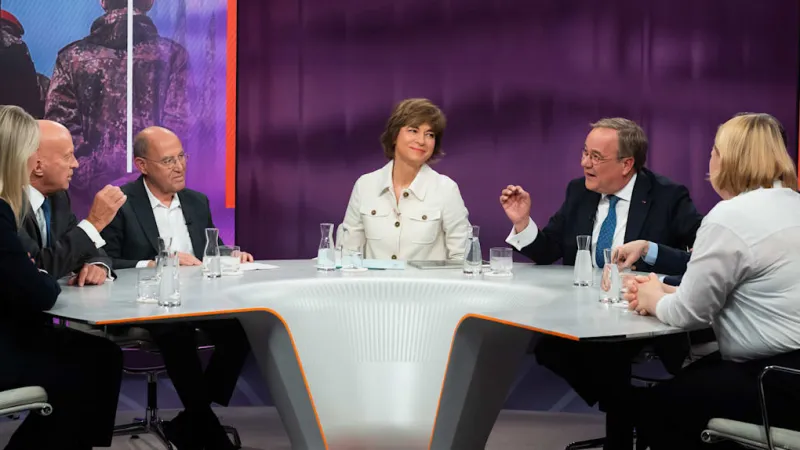
Berlin – A sharp verbal confrontation unfolded on the Maybrit Illner political talk show as Armin Laschet, a leading figure of Germany's Christian Democratic Union (CDU), fiercely challenged Rüdiger Lucassen, the defense policy spokesman for the Alternative for Germany (AfD) party. The heated exchange focused on Europes future, the legacy of Konrad Adenauer, and the contentious issue of German rearmament, culminating in Laschets direct interruption of Lucassen.
The highly anticipated segment, which bypassed discussions on international figures like President Donald Trump or Russian President Vladimir Putin, instead zeroed in on the internal ideological fissures within Germany, particularly concerning the AfD's increasingly prominent role in national discourse. Laschets animated interjection, "No, no, Mr. Lucassen," underscored the profound divisions between the centrist establishment and the surging populist right.
Laschet, a former Minister President of North Rhine-Westphalia, articulated a vision of Europe firmly rooted in democratic values and multilateral cooperation. He emphasized the historical responsibility of Germany within the European Union, echoing the foundational principles established by post-war leaders such as Konrad Adenauer, the first Chancellor of West Germany. For the CDU, Adenauer symbolizes reconciliation, European integration, and a commitment to Western alliances.
Lucassen, representing the AfD, presented a counter-narrative that often champions national sovereignty over supranational European integration. His party's platform frequently advocates for a less centralized European Union, urging member states to prioritize national interests. This stance directly contradicts the bedrock of German foreign policy as championed by parties like the CDU for decades.
The debate surrounding Germanys rearmament proved especially contentious. Following recent geopolitical shifts, Germany has embarked on a significant overhaul of its defense capabilities. Laschet likely framed this as a necessary step for collective security within NATO and the EU, while the AfD often expresses skepticism regarding extensive military commitments and potentially questions the necessity of such large-scale expenditure or specific alliance structures.
The intensity of the exchange reflects the broader political climate in Germany, where the AfD has seen a notable rise in electoral support. Recent polls have indicated the party gaining traction in various regions, leading to concerns among established parties about its growing influence. For instance, reports indicate the AfD has seized the lead in Berlin polls and even threatened a majority in Saxony-Anhalt, as highlighted by other media outlets.
Public television platforms like Maybrit Illner play a crucial role in shaping political debate in Germany, offering a direct forum for leaders to present their arguments and challenge opponents. The programs format allows for spontaneous and often unscripted moments, making such direct confrontations particularly impactful for the viewing public.
The clash between Laschet and Lucassen also illuminated the differing interpretations of German history and its implications for contemporary policy. The legacy of Adenauer, for example, is often invoked by the CDU to underscore its commitment to a strong, integrated Europe, whereas the AfD frequently seeks to redefine German national identity in ways that challenge these established narratives.
Observers suggest that these types of televised debates are becoming increasingly vital as Germany grapples with complex challenges, from economic pressures to international security concerns. The ability of parties to articulate their visions and defend their positions under scrutiny helps voters understand the stark choices confronting the nation.
Ultimately, the confrontation served as a microcosm of the ongoing ideological struggle within German politics. It highlighted the deep philosophical chasm between those advocating for continued European integration and robust international alliances, and those championing a more national-centric approach to governance and defense. The passionate nature of the debate signals that these issues will remain at the forefront of Germany's political agenda for the foreseeable future.
This dynamic ensures that the AfD's political trajectory and its interactions with mainstream parties like the CDU will continue to be a dominant theme in German news. The televised clash on Illner was not merely a political show; it was a vivid demonstration of the battle for Germany's future direction.