 Chandra Wijayanto
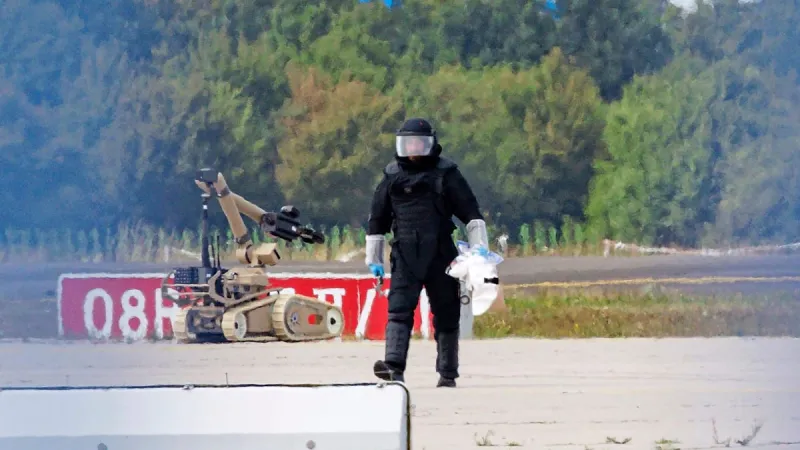
In a stark assessment, aviation expert Heinrich Großbongardt has unequivocally declared recent drone incidents at Leipzig Airport, Germany, to be a deliberate act of sabotage, profoundly warning of emergent dangers to critical infrastructure. This pronouncement follows a series of alarming occurrences that have sparked widespread concern among German authorities and security analysts.
Großbongardt, a prominent voice in European aviation circles, underscored the sophistication and intent behind the drone deployments. His analysis moves beyond mere negligence or accidental incursions, pointing instead to a calculated effort to disrupt operations and test security perimeters at one of Germany’s vital logistics hubs.
The incidents at Leipzig Airport, a significant cargo and passenger gateway, have drawn comparisons to a broader pattern of unconventional threats. Reports indicated the discovery of an explosive drone near a Ukrainian aircraft at the facility, escalating the gravity of the situation and hinting at potential geopolitical dimensions.
This specific discovery has intensified fears that such acts are not isolated events but rather part of a coordinated campaign. Experts suggest these incidents could signify a profound shift in modern asymmetric warfare, where non-state or hostile state actors leverage readily available technology to create widespread disruption.
Indeed, the presence of an explosive device near a Ukrainian asset at a German airport signals a new era of warfare, challenging traditional notions of border security and national defense. The accessibility of drone technology means that the barrier to entry for such destabilizing acts has significantly lowered, demanding innovative counter-measures.
Further compounding these concerns, the Leipzig drone discovery ignited alarm over Russian interference in Germany. While no definitive proof of attribution has been publicly released, the context of current international relations, particularly concerning Ukraine, places such incidents under intense scrutiny for potential foreign state involvement.
Airports, by their very nature, present a complex security challenge. Their vast perimeters and constant movement of aircraft and personnel make them vulnerable to aerial threats like drones. The incidents at Leipzig underscore the imperative for robust and adaptive anti-drone technologies, including advanced radar systems, jammers, and kinetic interceptors.
Großbongardt’s assessment is a wake-up call for not only Germany but for the entire European aviation sector. He emphasizes the urgent need for enhanced intelligence sharing and collaborative defense strategies across national borders to effectively combat these emerging threats.
The economic implications of such sabotage acts are also substantial. Frequent disruptions could erode confidence in air travel and cargo logistics, potentially impacting Germany’s role as a major European economic power. Ensuring uninterrupted and secure operations is paramount for both national security and economic stability.
Authorities are undoubtedly intensifying investigations into the origin and perpetrators of these drone incidents. The focus will extend beyond immediate security responses to understanding the motives and capabilities of those seeking to exploit these vulnerabilities.
In the broader geopolitical landscape, the incidents at Leipzig resonate with other reports of destabilizing activities. For instance, reports regarding Kyiv reeling from deadly strikes and Russian raids killing 17 in Kyiv, juxtaposed with the Leipzig discovery, underscore a pervasive environment of elevated threat and deliberate targeting of civilian or strategic assets.
The implications of Großbongardt’s definitive statement extend beyond the immediate threat to Leipzig Airport. It necessitates a comprehensive reassessment of national security protocols, especially those guarding critical infrastructure against technologically advanced and deliberately hostile incursions. The era of drone sabotage is not a theoretical concern but an active, unfolding reality.