 Chandra Wijayanto
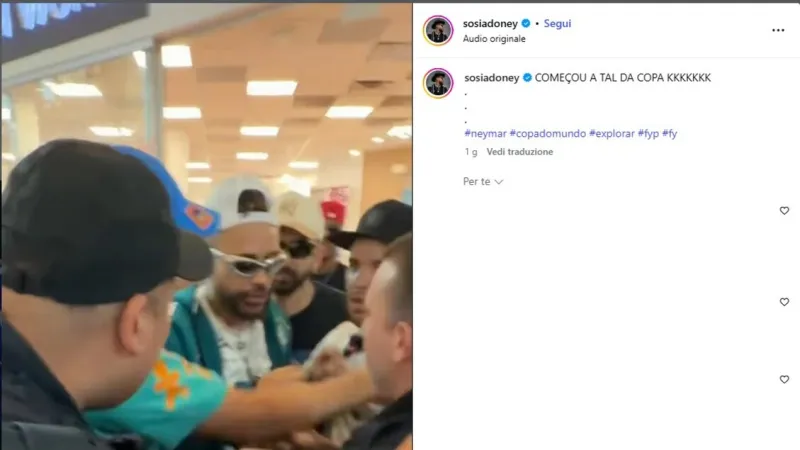
UNITED STATES A Brazilian influencer, renowned for his striking resemblance to soccer icon Neymar Jr., recently incited a considerable commotion at a bustling United States shopping center when hundreds of eager fans swarmed him, believing him to be the sports superstar, prompting swift intervention from security personnel to restore order.
The incident unfolded rapidly as shoppers, recognizing the influencer often dubbed Neymar's doppleganger, began to gather. What initially appeared as mild curiosity quickly escalated into a dense throng, eager for photographs and autographs. The sheer volume of people made navigation within the mall challenging and raised immediate safety concerns.
Videos circulating on social media platforms depict the influencer, clad in attire similar to Neymar's typical casual wear, attempting to navigate the burgeoning crowd. His attempts at polite refusal were often overwhelmed by the sheer enthusiasm and forward momentum of the crowd. Security guards, initially taken by surprise, soon converged on the scene.
Mall security personnel, visibly overwhelmed by the unexpected surge, worked diligently to form a protective perimeter around the influencer. Their primary objective became crowd control and ensuring the safety of both the public and the mistaken celebrity. The situation underscored the immense global reach of sports celebrities like Neymar Jr., whose presence, even by proxy, can ignite such fervent public reactions.
The Brazilian star Neymar Jr., a forward for Al-Hilal and the Brazil national team, remains one of the most recognizable athletes worldwide. His exploits on the pitch, particularly during major tournaments like the World Cup, consistently capture international headlines. The passion of Brazilian football fans, in particular, is legendary, often leading to exuberant displays of support.
This event serves as a vivid illustration of the blurred lines between celebrity and imitation in the digital age. Influencers who cultivate resemblances to famous personalities often garner significant online followings, translating virtual attention into real-world encounters that can, at times, become unmanageable.
Eyewitness accounts described a palpable excitement mixed with confusion. "I genuinely thought it was him," stated one shopper who wished to remain anonymous. "The way he moved, his hair, even his outfit. It was uncanny. Everyone just wanted a glimpse." Such testimonials highlight the persuasive power of visual similarity and the public's eagerness to engage with celebrity culture.
The situation required a strategic deployment of additional security personnel from across the shopping center. It took considerable effort to disperse the crowd and safely escort the influencer from the premises, thereby restoring the usual flow of mall operations. This spontaneous public gathering served as an unscheduled test of the mall's emergency response protocols.
Incidents involving celebrity look-alikes causing public disturbances are not entirely unprecedented. Throughout history, individuals bearing uncanny resemblances to monarchs, political figures, or entertainers have, intentionally or otherwise, drawn significant attention. However, the scale and speed of this particular event were notable, amplified by instantaneous social media sharing.
The global phenomenon of sports idols, from football to basketball, consistently generates immense public interest. Figures like David Beckham, whose own global icon status was recently honored, demonstrate the enduring appeal of athletic excellence combined with a strong public persona.
While the influencer's identity remains largely unconfirmed beyond his online persona, the incident unequivocally demonstrated the enduring power of celebrity perception. It offered a fleeting, albeit chaotic, glimpse into the fervor that accompanies genuine global superstars like Neymar Jr., particularly among their dedicated fan bases, wherever they may be.