 Edward DP Situmorang
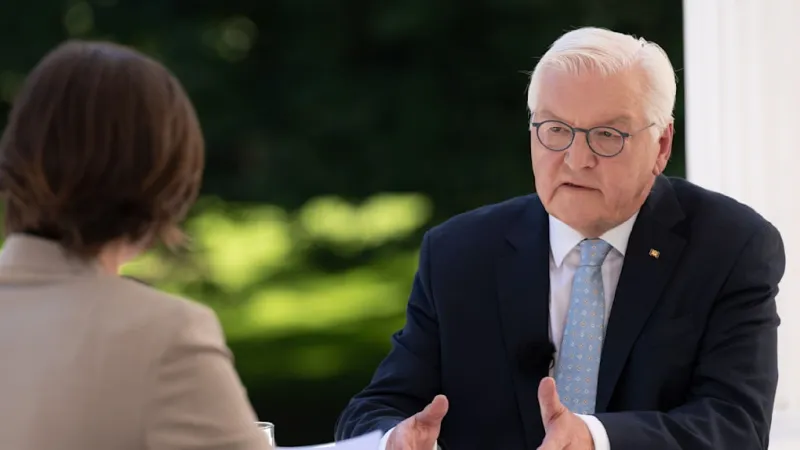
Germany – German President Frank-Walter Steinmeier declared a grave international epochal rupture during a recent ZDF interview, asserting that Russia has systematically dismantled the European security order while President Donald Trump's administration increasingly diverges from long-held American values and established foreign policy tenets.
Steinmeier articulated a deep concern over a significant turning point in global politics, a fundamental shift that he describes as a dual break with the foundations of post-Cold War stability. This profound transformation, according to the German head of state, presents unprecedented challenges to international cooperation and peace.
His critique centered first on the Russian Federation, accusing Moscow of a deliberate and destructive campaign against the security architecture that has underpinned stability across the European continent for decades. This includes actions that have fundamentally undermined trust and violated international law, creating a volatile new reality.
Specifically, Steinmeier's remarks implicitly reference Russia's actions in Eastern Europe, which many nations view as a direct assault on sovereign borders and the principles of non-aggression. These actions have not only disrupted regional peace but also forced a re-evaluation of defense strategies across NATO member states.
The German President then turned his attention to the United States, pointing to a distinct shift in direction under President Donald Trump. Steinmeier suggested that America is moving away from the values and multilateral commitments that traditionally defined its global leadership role.
This perceived divergence encompasses a range of policy considerations, from international agreements and alliances to diplomatic approaches. Steinmeier's assessment implies a potential weakening of the transatlantic bond, which has historically been a cornerstone of Western security and democratic ideals.
The core of the concern regarding President Trump's administration appears to lie in its redefinition of international engagement, often prioritizing national interests over broader collective security frameworks. This stance, Steinmeier argues, contributes to the overall global instability he identifies.
Such a twin assault on the established order—one through aggressive revisionism by Russia and the other through an internal reorientation of a major global power like the United States—creates a perilous vacuum. This absence of predictable frameworks, he fears, could lead to further fragmentation and conflict.
Germany, as a key player in the European Union and NATO, finds itself navigating an increasingly complex geopolitical landscape. Steinmeier's warning underscores the urgency for European nations to define their own strategic autonomy while grappling with eroding traditional alliances.
The implications of what Steinmeier termed this epochal rupture extend far beyond the immediate concerns of European security. It suggests a potential reconfiguration of global power dynamics, challenging the very concepts of international law and collective responsibility.
The German President's comments serve as a stark reminder of the profound uncertainties facing the international community. They emphasize a need for renewed diplomatic efforts and a concerted commitment to upholding foundational principles of peace and cooperation, even as the global order undergoes tumultuous change.
Analysts note that the stability of European nations and the wider transatlantic partnership relies heavily on a shared commitment to democratic values and collective defense. The perceived erosion of these pillars, as highlighted by Steinmeier, demands serious consideration from global leaders.
Furthermore, the discourse around Russia's actions continues to shape policy decisions worldwide, affecting everything from economic sanctions to military aid. The future of Russia sanctions packages remains a critical topic, as explored in discussions surrounding pivotal legislative actions, such as those that would follow an event like Senator Graham's death and its impact on a Russia sanctions package. Senator Graham's Death Threatens Pivotal Russia Sanctions Package.
Steinmeier's interview is seen as a high-level call to attention, urging both European and international stakeholders to critically assess the trajectory of global affairs and to proactively work towards mitigating the risks associated with this dual epochal rupture.