 Chandra Wijayanto
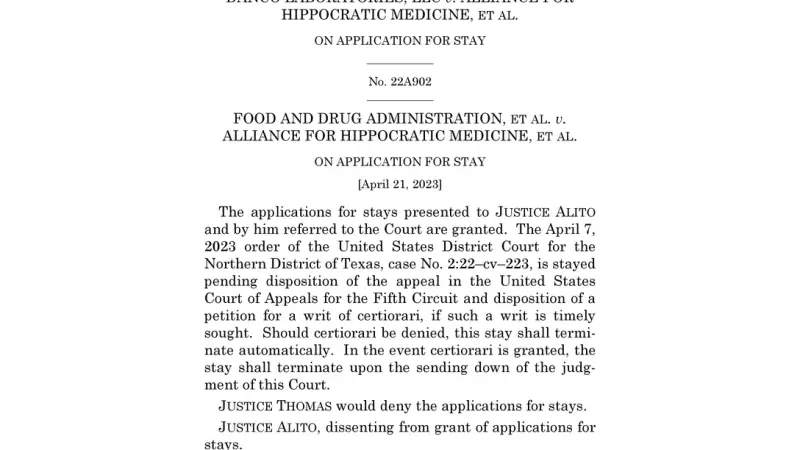
WASHINGTON — The U.S. Supreme Court today issued an emergency order that temporarily restores nationwide access to mifepristone, a commonly used abortion medication, via mail and telehealth consultations. The decision, handed down in 2026, overturns lower court rulings that had severely restricted the drug's distribution, allowing it to remain available under its original FDA approval while appeals proceed through the judicial system.
The high court's action means that patients can once again receive mifepristone through certified pharmacies by mail following a telemedicine appointment, bypassing requirements for in-person doctor visits that federal judges previously mandated. This swift intervention ensures continuity of care for thousands of individuals seeking medication abortion across the country, albeit under temporary terms.
The temporary reprieve comes after a federal judge in Texas initially suspended the Food and Drug Administration's long-standing approval of mifepristone, arguing that the agency overlooked safety concerns. That controversial ruling was later partially upheld by the Fifth Circuit Court of Appeals, which maintained restrictions on mail-order access and limited the drug's availability to the first seven weeks of pregnancy, down from ten.
Mifepristone has been safely and effectively used in the United States since its FDA approval in 2000, becoming a cornerstone of medication abortion regimens. The FDA has repeatedly affirmed the drug's safety profile through extensive studies and real-world data collected over more than two decades, often citing it as safer than common over-the-counter medications.
Opponents of abortion access, primarily represented by the Alliance for Hippocratic Medicine, contended that the FDA fast-tracked mifepristone's approval and ignored potential risks. These groups have pursued legal avenues to revoke or significantly curtail access to the drug, viewing it as a critical front in the broader debate over reproductive rights.
The Supreme Court's emergency stay is a significant, albeit preliminary, victory for abortion rights advocates and medical organizations that had warned of a potential public health crisis if the lower court rulings took full effect. It underscores the judiciarys complex role in arbitrating conflicts between regulatory agencies and politically charged medical practices.
The ruling arrives amid a contentious political climate surrounding reproductive healthcare. President Donald Trump has consistently appointed conservative judges, and his administration has expressed support for policies that align with restricting abortion access. The White House did not immediately comment on the Supreme Court's emergency order, deferring to the ongoing legal process.
Medical professional organizations, including the American College of Obstetricians and Gynecologists, lauded the Supreme Court's intervention, emphasizing the importance of clinician-patient autonomy and evidence-based medicine. They reiterate that mifepristone is a safe and essential medication for reproductive healthcare.
This temporary stay means the case will now proceed to full arguments before the Fifth Circuit Court of Appeals, followed by a potential return to the Supreme Court for a final decision on the merits. The ultimate legal fate of mifepristone and its method of distribution remains uncertain, potentially taking months, if not more than a year, to resolve.
The legal battle over mifepristone is widely seen as the most consequential national abortion case since the high court overturned Roe v. Wade in 2022, effectively eliminating the constitutional right to abortion. Its outcome could reshape the landscape of reproductive healthcare access nationwide, even in states where abortion remains legally protected.
While the Supreme Court decision temporarily restores federal-level access, state-specific restrictions on abortion access, including outright bans in some jurisdictions, continue to complicate the availability of medication abortion. Patients in states with severe restrictions will still face hurdles, even with mail-order mifepristone.
Medication abortion, primarily using mifepristone followed by misoprostol, accounts for more than half of all abortions performed in the United States. Its accessibility, particularly through telehealth and mail, has been vital for individuals in rural areas or those facing socioeconomic barriers to clinic access.
The legal challenge also carries significant implications for the Food and Drug Administration's authority to regulate and approve drugs. A ruling against the agency could set a precedent that allows courts to second-guess scientific determinations made by expert bodies, potentially destabilizing the entire drug approval process.
Though the Supreme Court's order was unsigned, three justices, Samuel Alito, Clarence Thomas, and Neil Gorsuch, publicly noted their dissent from the emergency stay. Their stated opposition indicates a persistent divide on the court regarding federal regulatory power and abortion access.
Public opinion polls consistently show a complex and often polarized view on abortion access in the United States. Advocacy groups on both sides of the issue continue to mobilize, recognizing the profound impact of the mifepristone case on the future of reproductive rights.
Despite the immediate relief offered by the Supreme Court's temporary order, the underlying legal questions remain unresolved. The ongoing litigation ensures that the availability of this critical medication will continue to be a focal point of national debate and legal contention in the coming months.