 Angel Doris
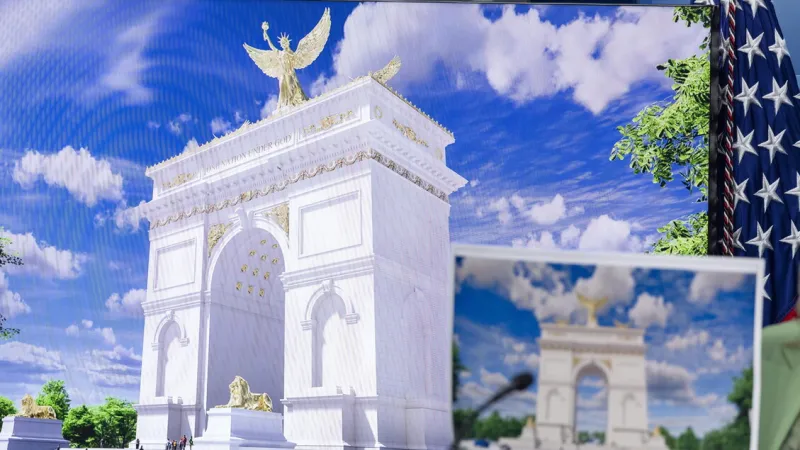
WASHINGTON, D.C. - President Donald Trump's ambitious proposal to erect a grand triumph arch in the nation's capital has received an initial green light, signaling a significant step forward for the monumental project. However, the plan immediately confronts a formidable obstacle: Washingtons stringent Height of Buildings Act, a century-old statute that could ultimately halt its construction.
The initial approval represents a conceptual endorsement, allowing the project to proceed to more detailed planning and design phases. This early endorsement suggests the administration's resolve to advance President Trump's vision for significant architectural statements within the capital city.
At the core of the potential conflict is the Height of Buildings Act of 1910. This pivotal legislation meticulously governs the maximum permissible height for structures across Washington, D.C., a measure designed to preserve the citys distinct low-rise aesthetic, protect federal building sightlines, and ensure a harmonious urban landscape.
The Act generally dictates that building heights cannot exceed the width of the adjacent street plus 20 feet, with further limitations for residential and commercial zones. These rules have profoundly shaped Washingtons characteristic horizontal skyline, setting it apart from towering metropolises worldwide.
President Trump has often expressed a desire for monumental architecture that reflects national pride and strength. A triumph arch, by its very nature, is typically designed to be a prominent, elevated structure, often soaring far above conventional building heights.
Such an architectural undertaking would likely necessitate a scale that could inherently conflict with the height limitations imposed by the 1910 Act. The design would face immense pressure to either conform to existing regulations or seek unprecedented exemptions.
Legal and urban planning experts indicate that securing an exemption or a variance from the Height of Buildings Act is exceptionally rare and would involve an arduous legislative or regulatory process. Historically, attempts to circumvent this law have met with considerable resistance.
The project will require approvals from several key federal and local bodies, including the National Capital Planning Commission and the Commission of Fine Arts. These entities are charged with safeguarding Washingtons unique architectural heritage and planning integrity.
Public reaction to such a project is expected to be divided. Supporters would likely hail it as a powerful symbol of American aspiration and a lasting legacy. Conversely, critics might voice concerns regarding urban sprawl, the substantial cost, or a perceived deviation from the capital's established architectural ethos.
The historical rationale behind the height law centers on preserving the visual dominance of the United States Capitol Building, the Washington Monument, and other iconic federal structures. It aims to prevent a dense forest of skyscrapers from obscuring these national treasures.
Architects designing any such monument would face an extraordinary challenge: to create a structure that is both grand and symbolic, yet respectful of, or somehow integrated within, the strict height parameters of the capital. This could involve innovative design approaches or alternative locations.
Pushing a project of this magnitude through against established urban planning statutes would necessitate significant political capital and potentially a legislative battle in Congress to amend the very law that has defined Washington's skyline for over a century.
The Trump administration has consistently prioritized projects emphasizing national infrastructure and monumental achievements, aligning with the broader theme of this proposed arch. It signifies a continued focus on tangible representations of American identity.
The debate over architectural legacy will undoubtedly ignite. Proponents could argue that a new triumph arch would enhance Washingtons array of monuments, adding a contemporary layer to its historical narrative. Opponents might contend it would detract from the existing solemnity and historical gravitas.
For now, while the concept of President Trump's triumph arch has cleared its initial hurdle, its ultimate realization remains contingent on navigating the formidable legal and legislative terrain of Washingtons long-standing building height regulations. The project faces a protracted battle, with the Height of Buildings Act poised as a formidable arbiter of its ultimate fate.
An artist's rendition depicts President Donald Trump's proposed triumph arch in Washington, D.C., which faces regulatory challenges regarding the city's height restrictions.