Gabriella
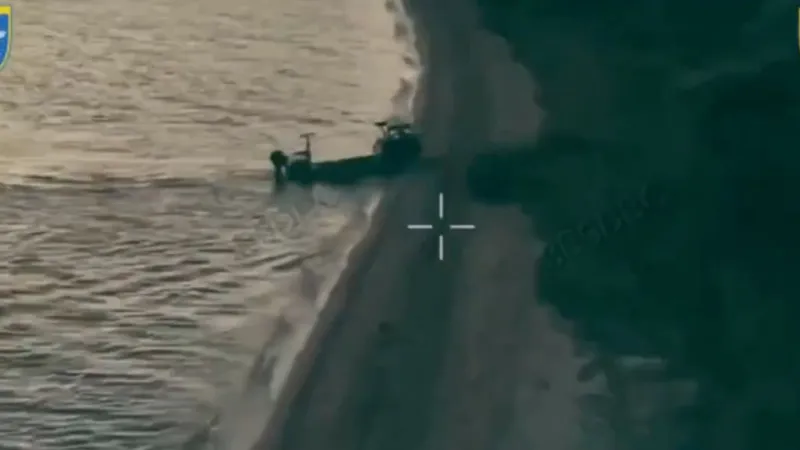
KYIV – Ukraine has announced what it describes as the world's inaugural amphibious assault conducted by an unmanned ground drone, marking a significant evolution in modern warfare. The armed robot was reportedly deployed from an unmanned boat onto the Russian-occupied Kinburn Peninsula where it subsequently engaged enemy positions.
The unprecedented operation, detailed by Ukrainian authorities, represents a novel application of robotic technology in a combat environment. This deployment signifies a pivotal moment, potentially redefining strategies for coastal incursions and land-based engagements. The specific details surrounding the drone's design and its operational capabilities remain largely undisclosed, adhering to wartime security protocols.
Sources indicate the armed unmanned ground vehicle (UGV) was transported across water by an unmanned surface vessel (USV) before independently navigating ashore. Upon reaching the peninsula, the robot commenced firing, targeting Russian forces stationed in the strategically vital region. This method dramatically mitigates the risk to human personnel during such hazardous missions.
The Kinburn Peninsula, located at the confluence of the Dnipro-Bug estuary and the Black Sea, holds considerable strategic importance. Its control provides a critical vantage point for artillery fire and drone launches targeting southern Ukrainian territories and shipping lanes. Russian forces have maintained a presence on the peninsula since the early stages of the full-scale invasion.
Military analysts worldwide are closely examining the implications of this development. The successful execution of an amphibious ground drone attack demonstrates a growing sophistication in Ukraine's indigenous drone program and its capacity for innovative tactical solutions against a larger adversary. This move could inspire similar adaptations in other global conflicts.
This advancement comes amidst Ukraine's persistent calls for enhanced military aid, particularly in advanced air defense systems, as articulated in previous statements emphasizing the need for quicker protection against barrages like those targeting Kyiv. The ongoing conflict has continuously pushed the boundaries of military technology and operational doctrine.
The utilization of such autonomous systems is not without its ethical and strategic debates. However, in the immediate context of the ongoing conflict, it offers Ukraine a distinct advantage by allowing for reconnaissance and engagement in high-risk zones without endangering human lives directly. This could be a game-changer for contested coastal areas.
Experts suggest this incident underscores the rapid pace at which unmanned systems are integrating into conventional military operations. From aerial surveillance drones to explosive-laden naval drones, the battlefield is increasingly populated by machines designed to perform tasks previously exclusive to human soldiers.
This new form of assault also highlights the evolving nature of combat, where the survival window for soldiers on the front lines can be alarmingly brief, as some intelligence assessments have previously suggested regarding Russian military personnel. Innovations like the amphibious ground drone aim to shift this perilous balance.
The successful disembarkation and engagement by a robotic system opens pathways for future complex operations, including logistics support, mine clearing, and even direct combat roles in urban or difficult terrain. Such technology requires robust command and control systems to ensure precision and prevent unintended escalation.
The development signals a potential paradigm shift, where conventional military assets may find themselves outmaneuvered or significantly challenged by agile, cost-effective robotic units. Nations globally will undoubtedly be reviewing their defense procurement and tactical training in light of these emerging capabilities.
While specific details on the drone's effectiveness against Russian positions are sparse, the mere fact of its deployment and engagement signifies a proof of concept that could accelerate the proliferation of similar technologies. The “new era of war” suggested by some observers appears to be gaining tangible form.
Ukraine's Ministry of Defense has yet to provide extensive technical specifications or operational footage, but the announcement itself carries considerable weight, intended perhaps to signal Ukraine's growing capacity for asymmetric warfare. This strategic communication serves both a domestic and international audience.
The continued investment in unmanned technology by Ukraine showcases a commitment to leveraging technological superiority where numerical or conventional military parity is difficult to achieve. This approach has been a hallmark of their defense strategy throughout the conflict.
The broader implications extend to naval operations, where unmanned boats like the one used for transport are already proving effective in disrupting enemy naval assets and supply lines. Combining these with ground-based robots creates a synergistic effect that amplifies their individual capabilities.
This incident also compels other military powers to reconsider their defensive postures against such amphibious robotic threats. Coastal defenses, traditionally designed to repel human-crewed landings, must now account for autonomous units that operate with different parameters and risk profiles.
The global defense industry is likely to witness increased investment and research into similar multi-domain robotic platforms. The race to develop and counter such technologies is accelerating, transforming the military-industrial complex.
The deployment on the Kinburn Peninsula underscores Ukraine's determined efforts to reclaim all occupied territories, employing a combination of conventional forces and cutting-edge technological innovations to achieve its objectives. The future battlefield will increasingly be defined by such unmanned endeavors.